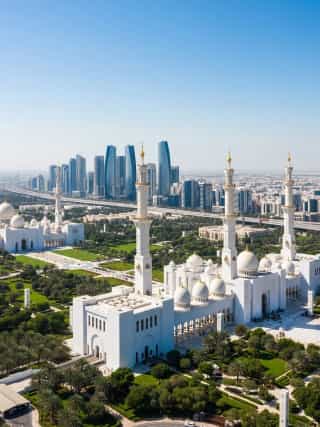
Abu Dhabi - The Capital of United Arab Emirates
- Population
- 1,482,816
- Language
- Arabic
- Continent
- Asia
- Since
- 1971
- Eco Ranking
- 51/195
Source: Environmental Performance Index 2024.
About Abu Dhabi
Abu Dhabi serves as the political and administrative capital of the United Arab Emirates, holding this role since the federation was established in 1971. The emirate of Abu Dhabi, largest of the seven emirates by land area, provides the federation's president under an unwritten convention: the ruler of Abu Dhabi has held the UAE presidency since independence. The federal government, including the Supreme Council, Council of Ministers, and Federal National Council, operates from Abu Dhabi. The city also hosts the headquarters of the Abu Dhabi National Oil Company (ADNOC), which underpins the emirate's financial dominance within the federation. While Dubai attracts far greater commercial activity and international attention, it holds no federal governmental authority. Abu Dhabi controls roughly 90% of the UAE's oil reserves, giving it structural supremacy over national policy regardless of Dubai's economic prominence. The UAE presidency has remained within the Al Nahyan ruling family of Abu Dhabi without interruption since 1971.
About United Arab Emirates
The United Arab Emirates is a federal absolute monarchy comprising seven hereditary emirate-states, each governed by its own ruling family. Federal authority is constitutionally anchored in Abu Dhabi, whose ruler serves as president. The UAE was formed in 1971 following British withdrawal from the Gulf, uniting emirates that had previously been British protectorates known as the Trucial States. There is no universal suffrage; the Federal National Council is partially elected by a limited electorate designated by each emirate's ruler.
View Abu Dhabi on the map
Flight time from Abu Dhabi to other capitals
| City | Distance (km) | Flight Time |
|---|---|---|
| Rome | 4300 | 5h 4m |
| Paris | 5200 | 6h 7m |
| London | 5500 | 6h 28m |
| Singapore | 5900 | 6h 56m |
| Cape Town | 7500 | 8h 49m |
| Tokyo | 8100 | 9h 32m |
| Washington, D.C. | 11300 | 13h 18m |
| Canberra | 12000 | 14h 7m |
| Buenos Aires | 13500 | 15h 53m |
Capitals with similar population to Abu Dhabi
| City | Population |
|---|---|
| Ulaanbaatar | 1,584,200 |
| Muscat | 1,560,330 |
| Abu Dhabi | 1,482,816 |
| Sofia | 1,405,612 |
| Belgrade | 1,405,192 |
| Dublin | 1,388,233 |
| Montevideo | 1,381,611 |
Capitals with similar eco ranking to Abu Dhabi
Source: Environmental Performance Index 2024.
Frequently Asked Questions
Why is Abu Dhabi the capital of the UAE and not Dubai?
Abu Dhabi was designated the federal capital when the UAE was founded in 1971 because it is the largest and wealthiest emirate, controlling the majority of the country's oil reserves. An unwritten constitutional convention grants the ruler of Abu Dhabi the UAE presidency. Dubai, despite its commercial dominance, holds no federal governmental authority.
When did Abu Dhabi become the capital of the UAE?
Abu Dhabi became the federal capital on 2 December 1971, when the United Arab Emirates was formally established following the end of British protectorate status over the Trucial States. Six emirates joined at founding; Ras Al Khaimah joined in February 1972.
Is Abu Dhabi the largest city in the UAE?
No. Dubai is the most populous city in the UAE with approximately 3.5 million residents, compared to Abu Dhabi's roughly 1.5 million. Abu Dhabi is nonetheless the political capital and seat of all federal government institutions.
What government institutions are based in Abu Dhabi?
The UAE's Supreme Council of Rulers, Council of Ministers, Federal National Council, and federal judiciary are all based in Abu Dhabi. The Presidential Palace (Qasr Al Watan) and most federal ministries operate from the capital.
Who is the head of state of the UAE and where do they govern from?
The President of the UAE is constitutionally the ruler of Abu Dhabi, currently Sheikh Mohamed bin Zayed Al Nahyan, who assumed the presidency in 2022 following the death of Sheikh Khalifa. The president governs from Abu Dhabi, which serves as the seat of all federal executive authority.
Sights and landmarks
Climate and best time to visit
Culture and customs
Economy