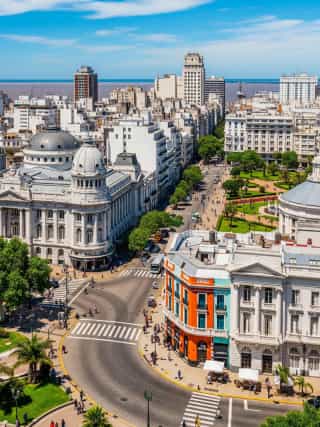
Montevideo - The Capital of Uruguay
- Population
- 1,381,611
- Language
- Spanish
- Continent
- South America
- Since
- 1830
- Eco Ranking
- 99/195
Source: Environmental Performance Index 2024.
About Montevideo
Montevideo was founded by Spanish colonial forces in 1724, originally as a military outpost to counter Portuguese expansion from Brazil. It became the capital of the Eastern Republic of Uruguay when the country achieved independence in 1828, after a turbulent period involving Portuguese, Brazilian, and Argentine claims to the territory. Uruguay's independence was partly brokered by British diplomatic intervention as a buffer state between Argentina and Brazil, a geopolitical role that shaped the country's subsequent neutralist foreign policy. Montevideo is the seat of all three branches of Uruguay's federal government and hosts the headquarters of MERCOSUR, the South American trade bloc. The city is home to approximately half of Uruguay's entire national population, an unusually high demographic concentration for a capital. Uruguay has been widely regarded as one of Latin America's most stable democracies, with competitive multiparty elections and strong institutional norms. The country legalized same-sex marriage in 2013 and cannabis in 2014, both decisions made through legislation passed in Montevideo. Montevideo is the southernmost capital city in South America.
About Uruguay
Uruguay is a presidential republic with a strong democratic tradition. The Frente Amplio (Broad Front), a center-left coalition, governed from 2005 to 2020, overseeing significant social reforms. The country has a history of stable transitions of power and consistently ranks among the least corrupt and most democratic countries in Latin America. Uruguay has no significant natural resources and relies on agriculture, financial services, and trade. It is a founding member of MERCOSUR and maintains close ties with Argentina and Brazil, its two much larger neighbors, whose geopolitical interests defined its founding as an independent buffer state.
View Montevideo on the map
Flight time from Montevideo to other capitals
| City | Distance (km) | Flight Time |
|---|---|---|
| Buenos Aires | 200 | 0h 14m |
| Cape Town | 6700 | 7h 53m |
| Washington, D.C. | 8500 | 10h 0m |
| London | 11000 | 12h 56m |
| Paris | 11000 | 12h 56m |
| Rome | 11000 | 12h 56m |
| Canberra | 11800 | 13h 53m |
| Abu Dhabi | 13300 | 15h 39m |
| Singapore | 15700 | 18h 28m |
| Tokyo | 18600 | 21h 53m |
Capitals with similar population to Montevideo
Capitals with similar eco ranking to Montevideo
| City | Eco Rank |
|---|---|
| Kuwait City | 96 |
| South Tarawa | 97 |
| Mexico City | 98 |
| Montevideo | 99 |
| Windhoek | 100 |
| Dakar | 101 |
| Cairo | 102 |
Source: Environmental Performance Index 2024.
Frequently Asked Questions
Why is Montevideo the capital of Uruguay?
Montevideo was the largest and most significant colonial settlement in what became Uruguay, and it served as the administrative center from the time of independence in 1828. It was the natural choice for capital given its established port, population, and infrastructure at the time of nation formation.
When did Montevideo become the capital of Uruguay?
Montevideo became the capital of the independent Eastern Republic of Uruguay in 1828, following the Cisplatine War and the Convention of Montevideo, which ended Brazilian rule over the territory. Uruguay's independence as a buffer state was brokered in part by British diplomatic mediation.
What share of Uruguay's population lives in Montevideo?
Approximately half of Uruguay's total population of around 3.5 million lives in Montevideo or its metropolitan area. This level of demographic concentration in a single city is one of the highest for any capital city relative to national population, and it gives Montevideo an outsized influence on national politics and culture.
Is Uruguay considered a stable democracy?
Yes. Uruguay consistently ranks as one of the most democratic and least corrupt countries in Latin America. It has maintained competitive multiparty elections since the end of its military dictatorship in 1985 and has had peaceful transfers of power ever since. International democracy indices regularly place it among the top-ranked countries in the region.
What is MERCOSUR and why is its headquarters in Montevideo?
MERCOSUR (Mercado Común del Sur) is a South American trade bloc founded in 1991 by Argentina, Brazil, Paraguay, and Uruguay. Its administrative secretariat is headquartered in Montevideo. Uruguay's position as a smaller neutral state between Argentina and Brazil made it a logical host for the bloc's permanent institutions.
Sights and landmarks
Climate and best time to visit
Culture and customs
Economy