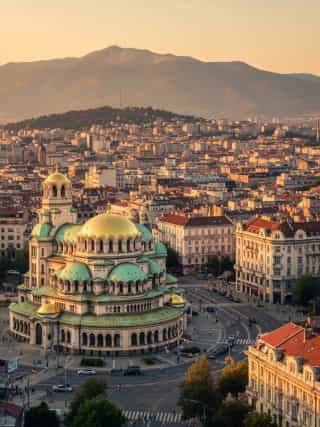
Sofia - The Capital of Bulgaria
- Population
- 1,405,612
- Language
- Bulgarian
- Continent
- Europe
- Since
- 1879
- Eco Ranking
- 37/195
Source: Environmental Performance Index 2024.
About Sofia
Sofia became the capital of Bulgaria in 1879, one year after Bulgaria gained autonomy from the Ottoman Empire following the Russo-Turkish War of 1877-1878. The city had been under Ottoman rule for nearly 500 years, from 1382 until the Russian military victory freed it in January 1878. Sofia was chosen as the capital over Tarnovo, the seat of the medieval Bulgarian Empire and the site of the constitutional assembly, partly because of its more central geographic position and its existing infrastructure. Bulgaria was the first Slavic state to adopt a written constitution, the Tarnovo Constitution of 1879. During the Cold War, Sofia was the capital of the People's Republic of Bulgaria, a Soviet-aligned communist state from 1946 to 1989. Bulgaria transitioned to democracy following the fall of communism in November 1989 and joined NATO in 2004 and the European Union in 2007. The National Assembly, the Council of Ministers, and the presidency are all located in central Sofia.
About Bulgaria
Bulgaria is a parliamentary republic in which the prime minister holds executive power and the president has a largely ceremonial role. Bulgaria joined NATO in 2004 and the EU in 2007. It has experienced significant political instability, with multiple snap elections in the early 2020s. Bulgaria is a candidate to join the eurozone but has faced delays due to inflation criteria not being met consistently.
View Sofia on the map
Flight time from Sofia to other capitals
| City | Distance (km) | Flight Time |
|---|---|---|
| Rome | 900 | 1h 4m |
| Paris | 1800 | 2h 7m |
| London | 2000 | 2h 21m |
| Abu Dhabi | 3500 | 4h 7m |
| Washington, D.C. | 7900 | 9h 18m |
| Cape Town | 8500 | 10h 0m |
| Singapore | 9100 | 10h 42m |
| Tokyo | 9200 | 10h 49m |
| Buenos Aires | 11900 | 14h 0m |
| Canberra | 15300 | 18h 0m |
Capitals with similar population to Sofia
| City | Population |
|---|---|
| Abu Dhabi | 1,482,816 |
| Sofia | 1,405,612 |
| Belgrade | 1,405,192 |
| Dublin | 1,388,233 |
| Montevideo | 1,381,611 |
| Tegucigalpa | 1,363,000 |
| Prague | 1,335,084 |
Capitals with similar eco ranking to Sofia
| City | Eco Rank |
|---|---|
| Bucharest | 34 |
| Washington, D.C. | 35 |
| Paramaribo | 36 |
| Sofia | 37 |
| Nassau | 38 |
| St. John's | 39 |
| San José | 40 |
Source: Environmental Performance Index 2024.
Frequently Asked Questions
Why is Sofia the capital of Bulgaria and not Tarnovo?
Sofia was chosen as Bulgaria's capital in 1879 over Tarnovo, the historical capital of the medieval Bulgarian Empire, primarily due to its more central geographic location within the newly autonomous Bulgarian territory. Tarnovo had hosted the constitutional assembly that drafted the Tarnovo Constitution but was seen as peripheral to the western Bulgarian lands. Sofia's existing infrastructure also played a role in the decision.
When did Bulgaria gain independence from the Ottoman Empire?
Bulgaria gained autonomy as a principality in 1878, following the Russo-Turkish War of 1877-1878 and the Treaty of Berlin. Full independence from the Ottoman Empire was declared in 1908 by Prince Ferdinand. Sofia had been captured from Ottoman forces by the Russian army in January 1878, ending nearly 500 years of Ottoman rule over the city.
How long was Sofia under Ottoman rule?
Sofia was under Ottoman rule from 1382, when Ottoman forces captured the city, until January 1878, when the Russian army liberated it during the Russo-Turkish War, a period of approximately 496 years. During this time, the city was known as Sofya and served as an important administrative centre in the Ottoman Empire's Balkan territories.
When did Bulgaria join the EU and NATO?
Bulgaria joined NATO on 29 March 2004 and became a member of the European Union on 1 January 2007. Both accessions were part of the broader expansion of Western institutions into Central and Eastern Europe following the end of the Cold War. Bulgaria had been a communist state aligned with the Soviet Union from 1946 until the democratic transition in 1989.
Is Sofia the largest city in Bulgaria?
Yes. Sofia is Bulgaria's largest city by a significant margin, with approximately 1.4 million residents in the city proper and around 1.7 million in the metropolitan area. Bulgaria's second city, Plovdiv, has approximately 350,000 residents. Sofia accounts for a substantial share of the country's total economic output and population.
Sights and landmarks
Climate and best time to visit
Regional significance
Culture and customs
Economy