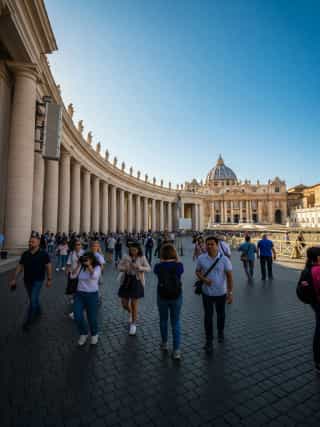
Vatican City - The Capital of Vatican City
- Population
- 825
- Language
- Italian
- Continent
- Europe
- Since
- 1929
- Eco Ranking
- -
Source: Environmental Performance Index 2024.
About Vatican City
Vatican City came into existence on 11 February 1929, when the Lateran Treaty was signed between the Holy See and the Kingdom of Italy under Mussolini. The agreement resolved the "Roman Question", the standoff that had persisted since 1870, when Italian forces annexed the Papal States and the papacy refused to recognise the new Italian state. The treaty created a sovereign territory of 0.44 km² within Rome, giving the Pope both spiritual authority over the Catholic Church and temporal authority over the world's smallest internationally recognised state. Governance is entirely theocratic. The Pope serves as head of state, head of government, and head of the Church simultaneously. Legislative, executive, and judicial powers are all vested in the papacy. The Pontifical Commission for Vatican City State handles day-to-day administration, while the Secretariat of State manages foreign relations. Vatican City maintains diplomatic relations with over 180 countries, though it is not a member of the United Nations. Vatican City is the only state in the world with Latin as an official language.
About Vatican City
Vatican City is an absolute monarchy and theocratic state governed by the Pope. It is the sovereign territory of the Holy See, which is a distinct legal entity in international law. The Holy See maintains permanent observer status at the United Nations and has signed treaties with dozens of countries. Despite its size, Vatican City issues its own passports, currency (euro by agreement), and postage stamps, and maintains the Vatican Gendarmerie Corps for internal security alongside the ceremonial Swiss Guard.
View Vatican City on the map
Flight time from Vatican City to other capitals
| City | Distance (km) | Flight Time |
|---|---|---|
| Rome | 0 | 0h 0m |
| Paris | 1100 | 1h 18m |
| London | 1400 | 1h 39m |
| Abu Dhabi | 4300 | 5h 4m |
| Washington, D.C. | 7200 | 8h 28m |
| Cape Town | 8500 | 10h 0m |
| Tokyo | 9900 | 11h 39m |
| Singapore | 10000 | 11h 46m |
| Buenos Aires | 11200 | 13h 11m |
| Canberra | 16200 | 19h 4m |
Capitals with similar population to Vatican City
Frequently Asked Questions
When did Vatican City become a sovereign state?
Vatican City became a sovereign state on 11 February 1929, through the Lateran Treaty signed between the Holy See and Italy. Prior to this, the papacy had been in a prolonged dispute with the Italian state since 1870, when Italy annexed the Papal States.
Who governs Vatican City?
The Pope holds all governing authority in Vatican City, legislative, executive, and judicial powers are all vested in the papacy. Day-to-day administration is carried out by the Pontifical Commission for Vatican City State, which operates under papal authority.
Is Vatican City a member of the United Nations?
Vatican City is not a full member of the United Nations, but the Holy See holds permanent observer state status. This allows it to participate in UN debates and activities without voting rights in the General Assembly.
What is the difference between Vatican City and the Holy See?
The Holy See is the governing body of the Catholic Church and has been a recognised subject of international law for centuries. Vatican City is the physical sovereign territory created in 1929 to give the Holy See a territorial base. The Holy See, not Vatican City, is the entity that maintains diplomatic relations with other countries.
What is the population of Vatican City?
Vatican City has a population of approximately 825 people, making it the least populous sovereign state and national capital in the world. Most residents are clergy, members of the Swiss Guard, or employees of the Holy See who hold Vatican citizenship by virtue of their role.