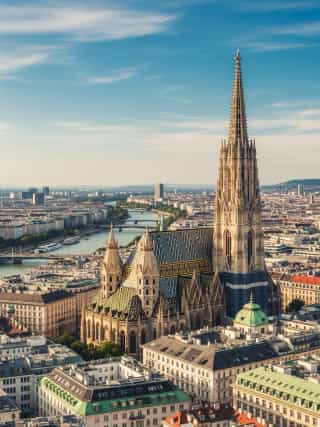
Vienna - The Capital of Austria
- Population
- 1,911,191
- Language
- German
- Continent
- Europe
- Since
- 500
- Eco Ranking
- 8/195
Source: Environmental Performance Index 2024.
About Vienna
Vienna has functioned as a major European capital for over five centuries. As the seat of the Habsburg dynasty, it governed one of Europe's largest empires from the 15th century onward. The Austro-Hungarian Empire, which Vienna led until its dissolution in 1918, encompassed much of central Europe and was a dominant force in continental politics. The empire's collapse at the end of World War I reduced Austria to a small republic, with Vienna, a city built for an empire of 50 million, now serving a country of under 7 million. In March 1938, Austria was annexed by Nazi Germany in the Anschluss, and Vienna ceased to function as an independent capital. After World War II, the city was divided into four occupation zones controlled by the United States, Britain, France, and the Soviet Union. This division lasted until the Austrian State Treaty of 1955, when Austria regained full sovereignty and declared permanent neutrality, a status it has maintained since. Vienna today hosts the headquarters of the United Nations Office at Vienna, the International Atomic Energy Agency (IAEA), OPEC, and the Organization for Security and Co-operation in Europe (OSCE). No other city of comparable size hosts as many major international organisations.
About Austria
Austria is a federal parliamentary republic composed of nine states (Bundesländer). The federal president serves as head of state, while the federal chancellor leads the government. Austria has maintained a policy of permanent neutrality since 1955, enshrined in constitutional law. This neutrality, combined with Vienna's central location in Europe, contributed to the city becoming a hub for international organisations during the Cold War. Austria joined the European Union in 1995.
View Vienna on the map
Flight time from Vienna to other capitals
| City | Distance (km) | Flight Time |
|---|---|---|
| Rome | 800 | 0h 56m |
| Paris | 1000 | 1h 11m |
| London | 1200 | 1h 25m |
| Abu Dhabi | 4200 | 4h 56m |
| Washington, D.C. | 7100 | 8h 21m |
| Tokyo | 9100 | 10h 42m |
| Cape Town | 9100 | 10h 42m |
| Singapore | 9700 | 11h 25m |
| Buenos Aires | 11800 | 13h 53m |
| Canberra | 15900 | 18h 42m |
Capitals with similar population to Vienna
| City | Population |
|---|---|
| Minsk | 1,982,444 |
| Panama City | 1,938,000 |
| Vienna | 1,911,191 |
| Bucharest | 1,883,425 |
| Kuala Lumpur | 1,808,000 |
| Warsaw | 1,790,658 |
| Rabat | 1,777,000 |
Capitals with similar eco ranking to Vienna
Source: Environmental Performance Index 2024.
Frequently Asked Questions
How long has Vienna been the capital of Austria?
Vienna has been the seat of power in the region for centuries, it became the Habsburg residence in the late 13th century and remained the imperial capital through the Habsburg and Austro-Hungarian empires until 1918. It has served as the capital of the modern Republic of Austria since its founding that same year.
What happened to Vienna after World War II?
After World War II, Vienna was divided into four occupation zones controlled by the US, Britain, France, and the Soviet Union, mirroring the division of Germany. This arrangement lasted until 1955, when the Austrian State Treaty restored Austrian sovereignty and the occupying powers withdrew.
Why does Vienna host so many international organisations?
Austria's constitutionally enshrined permanent neutrality, declared in 1955, made Vienna an acceptable host for both Western and Soviet-aligned international bodies during the Cold War. This legacy has been maintained, and Vienna remains one of four official UN headquarters cities alongside New York, Geneva, and Nairobi.
What was the Anschluss?
The Anschluss was the annexation of Austria by Nazi Germany on 12 March 1938. Vienna became a German city overnight, and Austria ceased to exist as an independent state until after Germany's defeat in 1945. The event is a significant and contested element of Austrian historical memory.
Is Vienna the largest city in Austria?
Yes, Vienna is by far the largest city in Austria, with a population of nearly 2 million, more than the next nine largest Austrian cities combined. This concentration of population in the capital is a direct legacy of Vienna's role as the center of a vast empire.
Sights and landmarks
Climate and best time to visit
Regional significance
Culture and customs