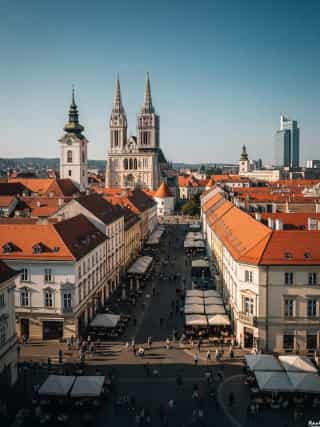
Zagreb - The Capital of Croatia
- Population
- 769,944
- Language
- Croatian
- Continent
- Europe
- Since
- 1557
- Eco Ranking
- 25/195
Source: Environmental Performance Index 2024.
About Zagreb
Zagreb has served as the administrative center of Croatian territory for centuries, functioning within the Habsburg Empire as the capital of the Kingdom of Croatia-Slavonia from the mid-16th century. The city was formed from the union of two hilltop settlements, Gradec and Kaptol, which merged administratively in 1850. Under Austro-Hungarian rule, Zagreb developed into a significant Central European city with institutions that would underpin Croatian statehood. Following World War I, Zagreb became part of the Kingdom of Serbs, Croats and Slovenes (later Yugoslavia). During World War II, it served as the capital of the Nazi-aligned Independent State of Croatia (NDH), a brutal puppet regime responsible for mass killings of Serbs, Jews, and Roma. Croatia declared independence from Yugoslavia on 25 June 1991. The Croatian War of Independence lasted until 1995, with Zagreb itself shelled by Yugoslav forces in May 1995. Croatia joined NATO in 2009 and the European Union in 2013, the most recent accession before North Macedonia joined. In March 2020, Zagreb was struck by a magnitude 5.5 earthquake, causing significant damage to the historic city center including the Zagreb Cathedral. Croatia adopted the euro and entered the Schengen Area simultaneously on 1 January 2023.
About Croatia
Croatia is a parliamentary republic and a member of both NATO and the European Union, which it joined in 2013 as the 28th member state. The Croatian Parliament (Sabor) sits in Zagreb, as does the president, who holds a largely ceremonial role. The prime minister leads the government. Croatia adopted the euro in January 2023 and joined the Schengen Area the same date. The country's path from a Yugoslav republic through a war of independence to EU membership took approximately two decades.
View Zagreb on the map
Flight time from Zagreb to other capitals
| City | Distance (km) | Flight Time |
|---|---|---|
| Rome | 500 | 0h 35m |
| Paris | 1100 | 1h 18m |
| London | 1300 | 1h 32m |
| Abu Dhabi | 4200 | 4h 56m |
| Washington, D.C. | 7200 | 8h 28m |
| Cape Town | 8900 | 10h 28m |
| Tokyo | 9300 | 10h 56m |
| Singapore | 9700 | 11h 25m |
| Buenos Aires | 11600 | 13h 39m |
| Canberra | 16000 | 18h 49m |
Capitals with similar population to Zagreb
| City | Population |
|---|---|
| Amsterdam | 873,555 |
| Dushanbe | 863,400 |
| Libreville | 797,003 |
| Zagreb | 769,944 |
| Oslo | 697,549 |
| Washington, D.C. | 689,545 |
| Chișinău | 685,889 |
Capitals with similar eco ranking to Zagreb
Source: Environmental Performance Index 2024.
Frequently Asked Questions
When did Zagreb become the capital of Croatia?
Zagreb has been the administrative center of Croatian territories since 1557, when the Croatian Sabor (parliament) permanently relocated there. It became the capital of the modern Republic of Croatia when the country declared independence in 1991.
What was Zagreb's role during World War II?
During World War II, Zagreb was the capital of the Independent State of Croatia (NDH), a Nazi-aligned puppet state established in 1941. The NDH regime was responsible for the mass murder of hundreds of thousands of Serbs, Jews, and Roma, primarily at the Jasenovac concentration camp.
When did Croatia gain independence from Yugoslavia?
Croatia declared independence on 25 June 1991, alongside Slovenia. The Croatian War of Independence that followed lasted until 1995, involving Yugoslav Army forces and Serb militias. International recognition came in January 1992, when the EU member states formally recognised Croatia.
When did Croatia join the European Union?
Croatia joined the European Union on 1 July 2013, becoming the 28th member state. It later adopted the euro and joined the Schengen Area on 1 January 2023, making it the most recently admitted full Schengen member at that time.
Was Zagreb affected by the 2020 earthquake?
Yes. On 22 March 2020, a magnitude 5.5 earthquake struck Zagreb, causing significant structural damage to the historic city center. The Zagreb Cathedral, one of Croatia's most prominent landmarks, was damaged and its spires had to be removed. The earthquake struck during the early weeks of the COVID-19 pandemic, complicating the emergency response.
Sights and landmarks
Climate and best time to visit
Culture and customs
Economy