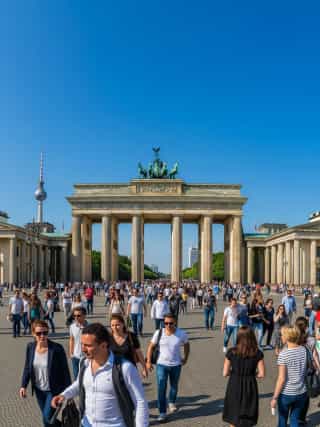
Berlin - The Capital of Germany
- Population
- 3,669,491
- Language
- German
- Continent
- Europe
- Since
- 1871
- Eco Ranking
- 3/195
Source: Environmental Performance Index 2024.
About Berlin
Berlin became the capital of a unified German state in 1871, when Bismarck's Prussia consolidated the German principalities into the German Empire and King Wilhelm I was proclaimed Emperor in the Hall of Mirrors at Versailles. The city served as the imperial capital until the end of World War I, then as capital of the Weimar Republic and subsequently the Third Reich. The burning of the Reichstag on 27 February 1933 was used by the Nazi government as justification for the Reichstag Fire Decree, which suspended civil liberties and accelerated the consolidation of Hitler's dictatorship. After Germany's defeat in 1945, Berlin was divided into four occupation zones. The city was split by the construction of the Berlin Wall on 13 August 1961, physically separating East Berlin, the capital of the German Democratic Republic, from West Berlin, which became a Western-backed enclave within East German territory. West Germany governed from Bonn. German reunification on 3 October 1990 restored Berlin as the capital of a unified state, and the federal government formally transferred back from Bonn between 1994 and 1999. The Reichstag, rebuilt with a glass dome symbolizing governmental transparency, was re-inaugurated as the home of the Bundestag in 1999.
About Germany
Germany is a federal parliamentary republic composed of 16 states (Länder), each with significant autonomous powers. The Basic Law, enacted in 1949 as a post-war constitution, was designed with explicit safeguards against authoritarianism, including a constructive vote of no confidence that prevents governments from being removed without a successor being simultaneously elected. Germany is a founding member of the EU and NATO.
View Berlin on the map
Flight time from Berlin to other capitals
| City | Distance (km) | Flight Time |
|---|---|---|
| London | 900 | 1h 4m |
| Paris | 900 | 1h 4m |
| Rome | 1200 | 1h 25m |
| Abu Dhabi | 4600 | 5h 25m |
| Washington, D.C. | 6700 | 7h 53m |
| Tokyo | 8900 | 10h 28m |
| Cape Town | 9600 | 11h 18m |
| Singapore | 9900 | 11h 39m |
| Buenos Aires | 11900 | 14h 0m |
| Canberra | 16100 | 18h 56m |
Capitals with similar population to Berlin
| City | Population |
|---|---|
| Amman | 4,061,150 |
| Dakar | 3,732,284 |
| Berlin | 3,669,491 |
| Abuja | 3,464,000 |
| Addis Ababa | 3,352,000 |
| Santo Domingo | 3,339,410 |
| Pyongyang | 3,255,288 |
Capitals with similar eco ranking to Berlin
Source: Environmental Performance Index 2024.
Frequently Asked Questions
When did Berlin become the capital of Germany?
Berlin became the capital of a unified Germany in 1871, when the German Empire was proclaimed. It had previously been the capital of Prussia. After World War II it was divided, and Bonn served as West Germany's capital from 1949 to 1990. Following reunification in 1990, Berlin was designated the capital of unified Germany, and the government fully relocated from Bonn by 1999.
Why was the Berlin Wall built?
The Berlin Wall was constructed by the East German government on 13 August 1961 to stop the massive emigration of East Germans to the West via Berlin. Before the Wall, an estimated 3.5 million East Germans had fled to the West since 1949. The Wall, with its death strip and guard towers, stood until 9 November 1989 when the East German government opened the border.
What was the significance of the Reichstag fire?
The Reichstag fire on 27 February 1933, just four weeks after Hitler became Chancellor, was used by the Nazi government to justify the Reichstag Fire Decree, which suspended constitutional civil liberties. The decree enabled mass arrests of political opponents and effectively marked the end of Weimar democratic governance, accelerating the legal consolidation of dictatorship.
Why did West Germany use Bonn as its capital instead of Berlin?
After World War II, Berlin was deep within Soviet-occupied East Germany, making it impractical and politically problematic as the capital of the new West German state. Bonn, a small city on the Rhine in western Germany, was chosen in 1949, partly because it was seen as a provisional, modest choice that would not signal permanence, given the expectation of eventual reunification.
Is Berlin the largest city in Germany?
Yes. Berlin is the largest city in Germany, with around 3.7 million residents. It is significantly larger than the second-largest city, Hamburg, which has around 1.9 million. Berlin's size reflects its role as the imperial and then national capital, though its economy was significantly disrupted during the decades of division.
Sights and landmarks
Climate and best time to visit
Culture and customs
Economy