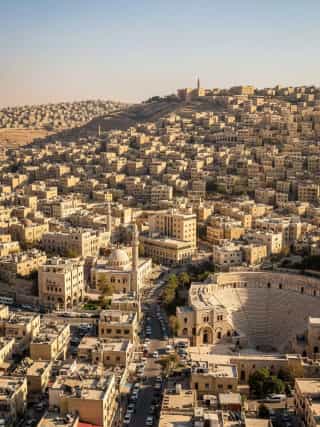
Amman - The Capital of Jordan
- Population
- 4,061,150
- Language
- Arabic
- Continent
- Asia
- Since
- 1921
- Eco Ranking
- 79/195
Source: Environmental Performance Index 2024.
About Amman
Modern Amman's political existence is largely a 20th-century construction. Before 1921, the site was a small settlement of a few thousand Circassian migrants who had arrived in the late 19th century. The British Mandate authorities selected it as the capital of the newly created Emirate of Transjordan in 1921, elevating Abdullah I of the Hashemite dynasty to the position of emir. The choice of Amman was pragmatic rather than historical: it had a railway junction and rudimentary infrastructure left from Ottoman-era development. Full independence from Britain came in 1946, when Transjordan became the Hashemite Kingdom of Jordan with Amman as capital. The city's population surged dramatically following the 1948 Arab-Israeli War and subsequent waves of Palestinian displacement, and again after the 1967 Six-Day War. Today Amman is home to the Royal Palace (Raghadan Palace), the Parliament, the Prime Minister's office, and virtually all government ministries. Jordan remains a constitutional monarchy in which the King holds substantial executive authority. Amman's rapid growth from a village to a metropolis of over 4 million people occurred almost entirely within a century.
About Jordan
Jordan is a constitutional monarchy in which the King holds executive authority, appoints the Prime Minister, and can dissolve Parliament. The Parliament is bicameral: the Senate is appointed by the King, while the Chamber of Deputies is elected. Jordan was created as a British Mandate territory in 1921 and gained full independence in 1946. The Hashemite royal family traces its lineage to the Prophet Muhammad's tribe, a claim that carries significant political legitimacy in the region.
View Amman on the map
Flight time from Amman to other capitals
| City | Distance (km) | Flight Time |
|---|---|---|
| Abu Dhabi | 2000 | 2h 21m |
| Rome | 2300 | 2h 42m |
| Paris | 3400 | 4h 0m |
| London | 3600 | 4h 14m |
| Cape Town | 7600 | 8h 56m |
| Singapore | 7900 | 9h 18m |
| Tokyo | 9100 | 10h 42m |
| Washington, D.C. | 9500 | 11h 11m |
| Buenos Aires | 12300 | 14h 28m |
| Canberra | 13900 | 16h 21m |
Capitals with similar population to Amman
Capitals with similar eco ranking to Amman
| City | Eco Rank |
|---|---|
| Astana | 77 |
| Podgorica | 78 |
| Santo Domingo | 78 |
| Port Louis | 79 |
| Tbilisi | 79 |
| Amman | 79 |
| Buenos Aires | 81 |
Source: Environmental Performance Index 2024.
Frequently Asked Questions
Why was Amman chosen as the capital of Jordan?
Amman was chosen by British Mandate authorities in 1921 primarily for practical reasons: it had an existing railway junction on the Hejaz Railway and some basic infrastructure. The British installed Emir Abdullah I there to administer the newly created Emirate of Transjordan, and the city grew into its role as capital from that point.
When did Amman become the capital of an independent Jordan?
Amman became the capital of fully independent Jordan on 25 May 1946, when the Hashemite Kingdom of Jordan was proclaimed following the end of British Mandate rule over Transjordan. This date is celebrated as Jordan's Independence Day.
Was Amman always a significant city?
No. Before British Mandate rule, Amman was a small agricultural settlement with only a few thousand residents, mostly Circassian migrants who had arrived in the 1870s. It had none of the historical urban significance of nearby cities such as Jerusalem or Damascus. Its political importance is almost entirely a product of the 20th century.
How did Palestinian displacement affect Amman's population?
The 1948 Arab-Israeli War and the 1967 Six-Day War drove large waves of Palestinian refugees into Jordan, many of whom settled in and around Amman. Jordan is the only Arab country to have granted full citizenship to Palestinian refugees at scale. Today, people of Palestinian origin make up an estimated 50-70% of Jordan's population.
Does the King of Jordan govern from Amman?
Yes. King Abdullah II governs from Amman, where both the Royal Court and the main governmental institutions are based. Under Jordan's constitution, the King holds executive power, appoints the Prime Minister and Cabinet, and commands the armed forces. The Parliament also sits in Amman.
Sights and landmarks
Climate and best time to visit
Culture and customs