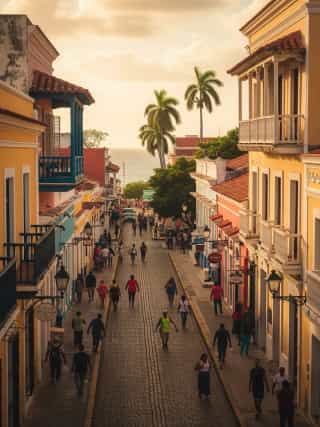
Santo Domingo - The Capital of Dominican Republic
- Population
- 3,339,410
- Language
- Spanish
- Continent
- North America
- Since
- 1496
- Eco Ranking
- 78/195
Source: Environmental Performance Index 2024.
About Santo Domingo
Founded in 1496 by Bartholomew Columbus, brother of Christopher Columbus, on the eastern bank of the Ozama River, Santo Domingo is the oldest continuously inhabited European city in the Americas. It served as the administrative centre of the Spanish Empire in the New World during the early colonial period, hosting the first cathedral, university, and hospital built in the Western Hemisphere. The city changed names and colonial masters multiple times, briefly under French and Haitian rule, before the Dominican Republic declared independence in 1844. Santo Domingo has been the capital since the country's founding and houses the executive, legislative, and judicial branches of the Dominican Republic. The Colonial City (Ciudad Colonial), the original settlement, was designated a UNESCO World Heritage Site in 1990. The Dominican Republic shares the island of Hispaniola with Haiti, and relations between the two countries have been shaped by a history of conflict, occupation, and migration.
About Dominican Republic
The Dominican Republic is a presidential republic and the most visited country in the Caribbean. It shares the island of Hispaniola with Haiti, the poorest country in the Western Hemisphere. The country experienced the 30-year dictatorship of Rafael Trujillo (1930-1961) and a brief US military intervention in 1965. It is a member of CARICOM (with observer status) and CAFTA-DR.
View Santo Domingo on the map
Flight time from Santo Domingo to other capitals
| City | Distance (km) | Flight Time |
|---|---|---|
| Washington, D.C. | 2400 | 2h 49m |
| Buenos Aires | 6000 | 7h 4m |
| London | 7000 | 8h 14m |
| Paris | 7200 | 8h 28m |
| Rome | 8000 | 9h 25m |
| Cape Town | 11000 | 12h 56m |
| Abu Dhabi | 12300 | 14h 28m |
| Tokyo | 13200 | 15h 32m |
| Canberra | 15800 | 18h 35m |
| Singapore | 17700 | 20h 49m |
Capitals with similar population to Santo Domingo
| City | Population |
|---|---|
| Abuja | 3,464,000 |
| Addis Ababa | 3,352,000 |
| Santo Domingo | 3,339,410 |
| Pyongyang | 3,255,288 |
| Asunción | 3,222,000 |
| Athens | 3,090,508 |
| Antananarivo | 3,058,800 |
Capitals with similar eco ranking to Santo Domingo
Source: Environmental Performance Index 2024.
Frequently Asked Questions
Why is Santo Domingo considered the oldest European city in the Americas?
Santo Domingo was founded in 1496 by Bartholomew Columbus, making it the first permanent European settlement in the Americas to survive to the present day. It served as the base for Spanish colonial expansion throughout the Caribbean and mainland Americas. It housed the first permanent cathedral, the first university, and the first hospital established by Europeans in the Western Hemisphere.
When did the Dominican Republic gain independence?
The Dominican Republic declared independence on 27 February 1844, separating from Haiti, which had controlled the entire island of Hispaniola since 1822. The independence movement was led by Juan Pablo Duarte and the secret society La Trinitaria. The date is celebrated as Dominican Independence Day. The country had previously been a Spanish colony and briefly under French and Haitian rule.
What is the relationship between the Dominican Republic and Haiti?
The Dominican Republic and Haiti share the island of Hispaniola. Haiti occupied the entire island from 1822 to 1844, during which period the Dominican Republic was governed from Port-au-Prince. Since independence, relations have been shaped by economic disparity, migration, and historical tensions, including the 1937 Parsley Massacre under Trujillo, in which thousands of Haitians were killed.
Is Santo Domingo the largest city in the Dominican Republic?
Yes. Santo Domingo is the Dominican Republic's largest city, with approximately 3.3 million residents in the district and around 4 million in the greater metropolitan area. It is also one of the largest cities in the Caribbean. The city functions as the country's political, economic, and cultural centre.
What was the Trujillo dictatorship?
Rafael Trujillo ruled the Dominican Republic as dictator from 1930 to 1961, when he was assassinated. His 31-year regime was characterised by extreme personalisation of power, surveillance, political murder, and cult of personality. Trujillo renamed Santo Domingo 'Ciudad Trujillo' after himself; the name was reversed after his assassination. His rule was marked by the 1937 massacre of Haitian migrants on the Haitian-Dominican border.
Sights and landmarks
Climate and best time to visit
Culture and customs
Economy