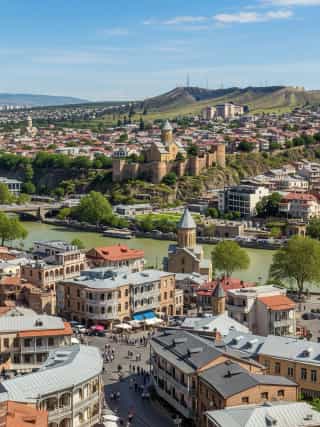
Tbilisi - The Capital of Georgia
- Population
- 1,049,498
- Language
- Georgian
- Continent
- Asia
- Since
- 1122
- Eco Ranking
- 79/195
Source: Environmental Performance Index 2024.
About Tbilisi
Tbilisi has served as the capital of Georgian states and kingdoms for most of the past millennium, first becoming the seat of the unified Georgian kingdom in 1122 when King David IV (David the Builder) captured it from the Seljuk Turks. The city sits at the crossroads of the South Caucasus, which has made it both strategically valuable and repeatedly contested, by Mongols, Persians, Ottomans, and Russians over the centuries. Russia annexed Georgia in 1801, and Tbilisi became the centre of Russian imperial administration in the Caucasus. Georgia declared independence in 1918, but was absorbed into the Soviet Union in 1921. Upon the collapse of the Soviet Union, Georgia re-established independence in 1991, with Tbilisi resuming its role as capital. The city's post-Soviet history has been turbulent. In August 2008, Russia and Georgia fought a brief war over the breakaway region of South Ossetia. Russia recognised South Ossetia and Abkhazia as independent states, a position shared by no other UN member state. Russian forces came within 40 kilometres of Tbilisi before a ceasefire was brokered. The conflict left roughly 20% of Georgia's territory under Russian control or influence. More recently, Georgia's government has pursued closer ties with Russia while nominally seeking EU membership, passing a controversial 'foreign agents' law in 2024, modelled on Russian legislation, that triggered mass protests. Tbilisi houses all three branches of government.
About Georgia
Georgia is a parliamentary republic with a president as head of state and a prime minister leading government. The country has formally pursued EU and NATO membership but its democratic trajectory has been contested, particularly since the Georgian Dream party, linked to oligarch Bidzina Ivanishvili, took power in 2012. The breakaway regions of South Ossetia and Abkhazia are outside Tbilisi's control and occupy approximately 20% of Georgia's internationally recognised territory.
View Tbilisi on the map
Flight time from Tbilisi to other capitals
| City | Distance (km) | Flight Time |
|---|---|---|
| Abu Dhabi | 2100 | 2h 28m |
| Rome | 2700 | 3h 11m |
| Paris | 3400 | 4h 0m |
| London | 3600 | 4h 14m |
| Singapore | 7400 | 8h 42m |
| Tokyo | 7800 | 9h 11m |
| Cape Town | 8800 | 10h 21m |
| Washington, D.C. | 9300 | 10h 56m |
| Buenos Aires | 13500 | 15h 53m |
| Canberra | 13600 | 16h 0m |
Capitals with similar population to Tbilisi
Capitals with similar eco ranking to Tbilisi
| City | Eco Rank |
|---|---|
| Astana | 77 |
| Podgorica | 78 |
| Santo Domingo | 78 |
| Amman | 79 |
| Port Louis | 79 |
| Tbilisi | 79 |
| Buenos Aires | 81 |
Source: Environmental Performance Index 2024.
Frequently Asked Questions
When did Tbilisi become the capital of Georgia?
Tbilisi became the capital of the unified Georgian kingdom in 1122 when King David IV captured it from the Seljuk Turks and made it his seat of power. The city had existed since the 5th century. It has served as Georgia's capital almost continuously since then, through various kingdoms, empires, and the Soviet period.
What happened during the 2008 Russia-Georgia war?
In August 2008, a five-day war broke out between Russia and Georgia over South Ossetia. Russian forces entered Georgian territory, advancing to within 40 kilometres of Tbilisi before a French-brokered ceasefire ended the fighting. Russia subsequently recognised South Ossetia and Abkhazia as independent states, a position rejected by virtually all other countries. The conflict froze approximately 20% of Georgia's internationally recognised territory under Russian control.
What is the foreign agents law Georgia passed in 2024?
The Georgian Dream government passed a law in 2024 requiring organisations receiving more than 20% of their funding from abroad to register as 'organisations carrying the interests of a foreign power.' Critics compared it to similar Russian legislation used to suppress civil society. The law triggered large-scale street protests in Tbilisi and was condemned by the EU and U.S. as incompatible with Georgia's stated goal of EU membership.
Is South Ossetia part of Georgia?
South Ossetia is internationally recognised as part of Georgia but has been outside Tbilisi's control since the early 1990s. Russia recognised it as independent following the 2008 war, and it is effectively administered under Russian protection. No UN member state other than Russia, and a handful of others, recognises South Ossetia's independence.
Is Georgia a member of the EU or NATO?
Georgia is not a member of either the EU or NATO. It applied for EU candidate status and received it in 2023, but the European Commission subsequently paused accession talks in 2024 following the passage of the foreign agents law and concerns about the government's democratic direction. NATO has not offered Georgia a membership timeline, partly due to the unresolved territorial disputes with Russia.
Sights and landmarks
Climate and best time to visit
Economy