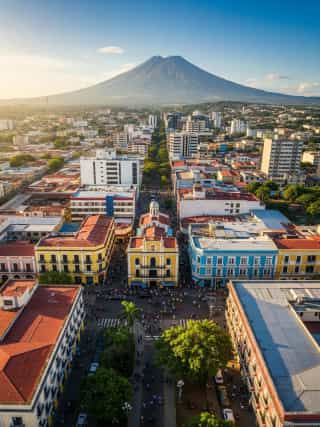
Managua - The Capital of Nicaragua
- Population
- 1,037,000
- Language
- Spanish
- Continent
- North America
- Since
- 1857
- Eco Ranking
- 75/195
Source: Environmental Performance Index 2024.
About Managua
Managua became Nicaragua's capital in 1857, chosen as a political compromise between the rival cities of León (the liberal stronghold) and Granada (the conservative stronghold), whose competition had driven the country into repeated civil conflict. As a neutral, centrally located settlement on the southern shore of Lake Xolotlán, Managua satisfied neither faction completely but was acceptable to both. On 23 December 1972, a catastrophic earthquake destroyed the city center, killing between 5,000 and 20,000 people. The Somoza dictatorship's misappropriation of international reconstruction aid was a direct cause of the popular discontent that fueled the 1979 Sandinista revolution, which overthrew Anastasio Somoza Debayle. The Sandinistas governed Nicaragua from Managua through the 1980s, waging a war against US-backed Contra rebels. After electoral defeat in 1990, the Sandinistas returned to power in 2006 under Daniel Ortega. Ortega has since consolidated authoritarian control, imprisoning political opponents, stripping critics of citizenship, and expelling Catholic bishops. Nicaragua under Ortega has been compared to the Somoza era it once overthrew. Managua is the seat of the National Assembly, the presidency, and the main state institutions, though the earthquake destruction means it lacks a historic urban center. Managua's downtown has never been fully rebuilt since 1972.
About Nicaragua
Nicaragua is a Central American republic bordered by Honduras and Costa Rica. It gained independence from Spain in 1821. The Somoza family dynasty ruled from 1936 until the 1979 Sandinista revolution. After a period of Sandinista governance and a US-backed Contra war in the 1980s, Nicaragua returned to electoral democracy in 1990. Daniel Ortega, a Sandinista leader from the 1979 revolution, was re-elected president in 2006 and has governed increasingly autocratically since, particularly after 2018 protests. The US has imposed sanctions on Nicaraguan officials.
View Managua on the map
Flight time from Managua to other capitals
| City | Distance (km) | Flight Time |
|---|---|---|
| Washington, D.C. | 3100 | 3h 39m |
| Buenos Aires | 6000 | 7h 4m |
| London | 8700 | 10h 14m |
| Paris | 8900 | 10h 28m |
| Rome | 9800 | 11h 32m |
| Cape Town | 12100 | 14h 14m |
| Tokyo | 12800 | 15h 4m |
| Canberra | 13900 | 16h 21m |
| Abu Dhabi | 14100 | 16h 35m |
| Singapore | 18100 | 21h 18m |
Capitals with similar population to Managua
Capitals with similar eco ranking to Managua
Source: Environmental Performance Index 2024.
Frequently Asked Questions
Why is Managua the capital of Nicaragua instead of León or Granada?
Managua was chosen as capital in 1857 as a compromise between León and Granada, which had been engaged in bitter political and military rivalry, León as the liberal base, Granada as the conservative stronghold. Neither city would accept the other as capital, so the government selected Managua, a smaller lakeside settlement between the two, as a neutral alternative.
What was the impact of the 1972 earthquake on Managua?
The earthquake of 23 December 1972 devastated Managua's city center, killing thousands and destroying most major buildings. International aid worth hundreds of millions of dollars flooded in for reconstruction, but the Somoza family and their associates diverted much of it for personal enrichment. This corruption radicalized large segments of Nicaraguan society and accelerated support for the Sandinista movement that overthrew Somoza in 1979.
When did Managua become the capital of Nicaragua?
Managua became Nicaragua's capital in 1857, replacing León. The decision followed decades of conflict between León and Granada and represented a political compromise intended to reduce inter-city rivalry. The capital had briefly been León, then Granada, before settling in Managua.
Who are the Sandinistas and how did they change Managua?
The Sandinistas (Frente Sandinista de Liberación Nacional, FSLN) were a Marxist revolutionary movement that overthrew the Somoza dictatorship in July 1979. They governed Nicaragua from Managua until losing the 1990 election to Violeta Chamorro. The Sandinista government nationalized industries, implemented literacy programs, and fought a US-backed Contra insurgency. Daniel Ortega, a Sandinista leader who was president from 1985-1990, returned to power in 2006.
Why does Managua lack a historic city center?
Managua's city center was almost entirely destroyed by the 1972 earthquake. Unlike most cities that rebuild their downtown cores, Managua's reconstruction was fragmented and incomplete, partly due to corruption and partly because commercial and residential growth spread outward rather than concentrating on the devastated center. Decades later, the former downtown remains largely empty, with the old cathedral left as a ruin.
Sights and landmarks
Climate and best time to visit
Culture and customs