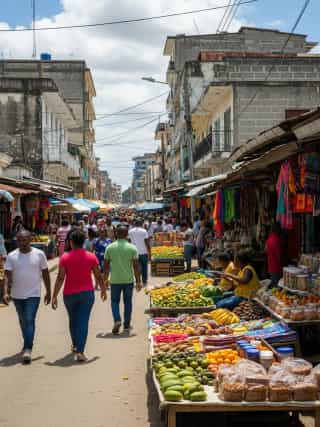
Port-au-Prince - The Capital of Haiti
- Population
- 2,618,894
- Language
- French
- Continent
- North America
- Since
- 1749
- Eco Ranking
- 146/195
Source: Environmental Performance Index 2024.
About Port-au-Prince
Port-au-Prince became the capital of Haiti in 1749, during French colonial rule of the western third of Hispaniola. The city's political significance is bound to Haiti's extraordinary and tragic history: the Haitian Revolution of 1791-1804 produced the world's first successful slave rebellion and the world's first Black republic, making Haiti a unique event in the history of colonialism. France recognized Haitian independence in 1825 only after Haiti agreed to pay an indemnity of 150 million francs to compensate former slaveholders, a debt that burdened the Haitian economy for over a century. On January 12, 2010, a magnitude 7.0 earthquake struck just outside Port-au-Prince, killing an estimated 160,000 to 316,000 people and causing catastrophic damage to government buildings, hospitals, and the National Palace. The disaster compounded decades of political instability and international dependency. In July 2021, President Jovenel Moïse was assassinated in his private residence, triggering a governance collapse. Port-au-Prince is now largely controlled by armed gangs that have displaced hundreds of thousands of residents and effectively paralyzed state institutions. A Kenya-led multinational security support mission deployed in 2024 to attempt to restore order. Haiti remains one of the most politically fragile states in the Western Hemisphere.
About Haiti
Haiti is a republic in a state of severe political and security crisis following the 2021 assassination of President Moïse and the collapse of functional state authority in much of Port-au-Prince. A transitional presidential council was established in 2024. Haiti shares the island of Hispaniola with the Dominican Republic. It is the poorest country in the Western Hemisphere by most economic metrics.
View Port-au-Prince on the map
Flight time from Port-au-Prince to other capitals
| City | Distance (km) | Flight Time |
|---|---|---|
| Washington, D.C. | 2300 | 2h 42m |
| Buenos Aires | 6100 | 7h 11m |
| London | 7200 | 8h 28m |
| Paris | 7400 | 8h 42m |
| Rome | 8200 | 9h 39m |
| Cape Town | 11200 | 13h 11m |
| Abu Dhabi | 12500 | 14h 42m |
| Tokyo | 13100 | 15h 25m |
| Canberra | 15500 | 18h 14m |
| Singapore | 17800 | 20h 56m |
Capitals with similar population to Port-au-Prince
Capitals with similar eco ranking to Port-au-Prince
| City | Eco Rank |
|---|---|
| Accra | 144 |
| Maseru | 144 |
| Nairobi | 144 |
| Port Moresby | 144 |
| Conakry | 145 |
| Port-au-Prince | 146 |
| Addis Ababa | 147 |
Source: Environmental Performance Index 2024.
Frequently Asked Questions
Why is Haiti historically significant?
Haiti was the first country in the world to abolish slavery through a successful revolution and the first Black republic in history. The Haitian Revolution began in 1791 and concluded in 1804 when Haiti declared independence from France, the only successful slave rebellion that led to the founding of a new state.
What was the impact of the 2010 earthquake on Port-au-Prince?
The January 12, 2010 earthquake devastated Port-au-Prince, killing between 160,000 and 316,000 people and leaving over 1.5 million homeless. The National Palace, parliament buildings, and much of the government infrastructure were destroyed. The disaster set back Haiti's development by decades and triggered a prolonged humanitarian crisis.
Why was Haiti required to pay France after independence?
France refused to recognize Haitian independence unless Haiti compensated former French colonists and slaveholders for their losses. Haiti agreed in 1825 to pay 150 million francs, later reduced to 90 million, to secure recognition and end a French naval blockade. This debt took Haiti until 1947 to fully repay and significantly hampered economic development.
What is the current political situation in Haiti?
Haiti has been in a deep political crisis since the assassination of President Jovenel Moïse in July 2021. The country has lacked a functioning elected government, and armed gangs control large parts of Port-au-Prince. A transitional presidential council was established in 2024, supported by a Kenya-led multinational security mission.
When did Port-au-Prince become the capital of Haiti?
Port-au-Prince was established as a colonial town in 1749 under French rule and became the capital of the French colony of Saint-Domingue. When Haiti declared independence in 1804, Port-au-Prince was confirmed as the capital of the new republic.
Sights and landmarks
Climate and best time to visit
Culture and customs
Economy