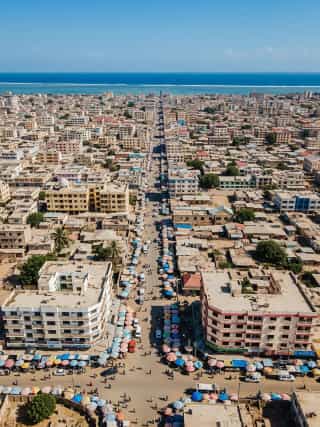
Mogadishu - The Capital of Somalia
- Population
- 2,610,483
- Language
- Somali
- Continent
- Africa
- Since
- 1960
- Eco Ranking
- -
Source: Environmental Performance Index 2024.
About Mogadishu
Mogadishu is one of the oldest cities on the East African coast, functioning as a trading hub for centuries before European colonization. It became the capital of Italian Somaliland under colonial rule and, upon independence in 1960, the capital of the Somali Republic formed by the union of British Somaliland and the Italian-administered territory. General Siad Barre seized power in a coup in 1969 and ruled until his fall in 1991, when Somalia descended into civil war. For more than two decades after 1991, Mogadishu had no functioning central government, it was controlled by competing clan militias and warlords. The city gained international attention in October 1993 during the Battle of Mogadishu, in which 18 American soldiers were killed in a failed mission to capture a warlord, an event documented in the book and film "Black Hawk Down." The internationally recognized Federal Government of Somalia was established in 2012 and has gradually extended its authority in Mogadishu, though the Al-Shabaab militant group continues to carry out attacks in the city. Somalia's federal parliament sits in Mogadishu but the government's authority beyond the capital remains limited.
About Somalia
Somalia is a federal republic whose government has operated in conditions of partial state collapse since 1991. The Federal Government of Somalia, re-established in 2012 with international support, controls Mogadishu and portions of south-central Somalia, but Al-Shabaab, an Al-Qaeda-affiliated militant group, controls large parts of rural southern Somalia. The self-declared Somaliland region in the northwest operates independently and has not been recognized by any foreign government. Somalia has received sustained support from the African Union Mission in Somalia (AMISOM, later ATMIS) and international partners. The country ranks consistently at or near the bottom of global governance and development indices.
View Mogadishu on the map
Flight time from Mogadishu to other capitals
| City | Distance (km) | Flight Time |
|---|---|---|
| Abu Dhabi | 2700 | 3h 11m |
| Cape Town | 4900 | 5h 46m |
| Rome | 5500 | 6h 28m |
| Singapore | 6500 | 7h 39m |
| Paris | 6600 | 7h 46m |
| London | 6900 | 8h 7m |
| Tokyo | 10300 | 12h 7m |
| Canberra | 11400 | 13h 25m |
| Buenos Aires | 11400 | 13h 25m |
| Washington, D.C. | 12600 | 14h 49m |
Capitals with similar population to Mogadishu
| City | Population |
|---|---|
| Quito | 2,781,641 |
| Lusaka | 2,731,696 |
| Taipei | 2,646,204 |
| Port-au-Prince | 2,618,894 |
| Mogadishu | 2,610,483 |
| Bamako | 2,446,800 |
| Ouagadougou | 2,415,266 |
Frequently Asked Questions
When did Mogadishu become the capital of Somalia?
Mogadishu became the capital of the independent Somali Republic on July 1, 1960, when British Somaliland and the Italian Trust Territory of Somalia united. It had previously served as the capital of Italian Somaliland under colonial rule.
What happened in Mogadishu in 1993?
In October 1993, US forces attempted to capture lieutenants of warlord Mohamed Farrah Aidid in Mogadishu. The operation turned into a prolonged urban battle in which two US Black Hawk helicopters were shot down and 18 American soldiers were killed. The event, known as the Battle of Mogadishu, led the United States to withdraw its forces from Somalia.
Does Somalia have a functioning government in Mogadishu?
Yes, but with significant limitations. The Federal Government of Somalia, established in 2012, operates from Mogadishu and has held several presidential elections. However, Al-Shabaab continues to conduct attacks in the city and controls substantial territory outside it. The government's authority is heavily dependent on African Union peacekeeping forces.
Why did Somalia collapse after 1991?
The fall of President Siad Barre's regime in January 1991 triggered a collapse of state institutions. Various clan-based factions that had united to overthrow Barre then turned on each other, fragmenting control of the country. No single group was able to establish a functioning government, leading to a prolonged period of statelessness and humanitarian crisis.
Is Mogadishu the largest city in Somalia?
Yes. Mogadishu is Somalia's largest city, with a population estimated at over 2.6 million. It has grown rapidly due to internal displacement caused by conflict and drought. The city serves as the political, economic, and administrative center of the Federal Government of Somalia.
Sights and landmarks
Climate and best time to visit
Culture and customs
Economy