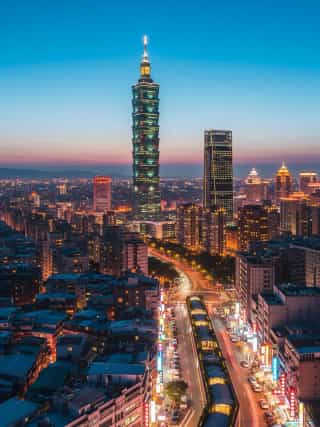
Taipei - The Capital of Taiwan
- Population
- 2,646,204
- Language
- Mandarin Chinese
- Continent
- Asia
- Since
- 1885
- Eco Ranking
- 60/195
Source: Environmental Performance Index 2024.
About Taipei
Taipei functions as the full seat of government for Taiwan, housing the presidency, the Executive Yuan, the Legislative Yuan, and the Judicial Yuan, yet its status as a national capital exists within one of the world's most consequential unresolved territorial disputes. The People's Republic of China (PRC) claims Taiwan as a province and refuses to recognise the government based in Taipei. The majority of UN member states do not maintain official diplomatic relations with Taiwan, though many sustain substantive unofficial ties. Taiwan's government traces its origin to the Republic of China (ROC), founded in 1912, which governed mainland China before losing the civil war to the Communist Party in 1949. The ROC government retreated to Taiwan, where it has governed ever since. Taipei became the provisional capital of the ROC in 1949, though it had been a significant administrative centre since Japan developed it as the capital of its Taiwan colony from 1895. Cross-strait tensions, the relationship between Taiwan and the PRC, have shaped Taipei's political environment continuously. The PRC has never renounced the use of military force to achieve unification, while Taiwan's population has developed a distinct political identity over decades. Taipei is home to over 2.6 million residents and is the centre of Taiwan's democratic institutions, established through gradual reform in the 1990s.
About Taiwan
Taiwan (officially the Republic of China) operates as a full democratic state with a directly elected president and a multiparty legislature. It controls Taiwan, Penghu, Kinmen, and Matsu. Most countries do not recognise it formally due to PRC pressure, but maintain unofficial relations through representative offices. Taiwan has one of Asia's most advanced economies and has been a leading producer of semiconductors, particularly through TSMC. Its political status remains the most significant flashpoint in U.S.-China relations.
View Taipei on the map
Flight time from Taipei to other capitals
| City | Distance (km) | Flight Time |
|---|---|---|
| Tokyo | 2100 | 2h 28m |
| Singapore | 3200 | 3h 46m |
| Abu Dhabi | 6700 | 7h 53m |
| Canberra | 7300 | 8h 35m |
| Rome | 9600 | 11h 18m |
| London | 9800 | 11h 32m |
| Paris | 9800 | 11h 32m |
| Washington, D.C. | 12600 | 14h 49m |
| Cape Town | 12700 | 14h 56m |
| Buenos Aires | 18900 | 22h 14m |
Capitals with similar population to Taipei
Capitals with similar eco ranking to Taipei
Source: Environmental Performance Index 2024.
Frequently Asked Questions
Why does most of the world not officially recognise Taipei as a capital?
The People's Republic of China maintains that Taiwan is a province of China and pressures other countries not to recognise the government in Taipei. As a result, Taiwan has formal diplomatic relations with only around a dozen states. Most countries maintain unofficial relations through trade and representative offices to avoid jeopardising ties with the PRC.
When did Taipei become the capital of Taiwan?
Taipei became the provisional capital of the Republic of China in 1949 when the ROC government retreated from mainland China after losing the civil war to Communist forces. Japan had previously developed Taipei as the administrative capital of Taiwan during its 1895-1945 colonial period. The city had also been a provincial capital under Qing dynasty rule from 1885.
What is the difference between Taiwan and the Republic of China?
The Republic of China (ROC) is the formal name of the government based in Taipei, established in 1912 and originally governing mainland China. After 1949, the ROC has governed only Taiwan and some smaller islands. 'Taiwan' is commonly used as an informal name for the state. The People's Republic of China (PRC) is the separate government established by the Communist Party in 1949 and based in Beijing.
Does Taiwan have a fully functioning democratic government?
Yes. Taiwan has held direct presidential elections since 1996 and operates a multiparty democratic system with a freely elected legislature. It has peacefully transferred power between political parties on multiple occasions. International observers consistently rate it as a full democracy, with strong civil liberties and press freedom.
Is Taipei the largest city in Taiwan?
Taipei municipality has a population of approximately 2.6 million, but New Taipei City, which surrounds Taipei, has a larger official population of over 4 million. Together, the greater Taipei metropolitan area contains nearly 7 million people, about 30% of Taiwan's total population.
Sights and landmarks
Climate and best time to visit
Culture and customs