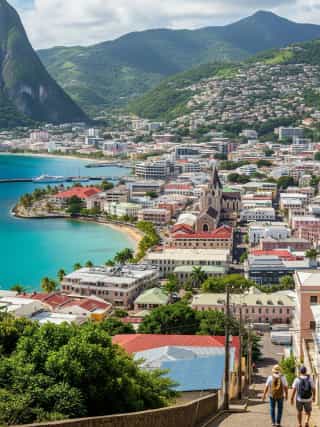
Castries - The Capital of Saint Lucia
- Population
- 22,000
- Language
- English
- Continent
- North America
- Since
- 1650
- Eco Ranking
- 56/195
Source: Environmental Performance Index 2024.
About Castries
Castries has served as the administrative center of Saint Lucia since the island was formally colonized by the French in 1650. Control of the island, and its capital, changed hands fourteen times between France and Britain before Saint Lucia was finally ceded to Britain under the Treaty of Paris in 1814. This repeated transfer of sovereignty explains the island's dual French-Creole and British cultural and administrative heritage. The city was named after the Marquis de Castries, a French Minister of the Navy, during the French colonial period. Castries was largely destroyed by fire four times in the 19th and early 20th centuries, most severely in 1948, which accounts for its largely modern built form. Saint Lucia gained independence from Britain in 1979, and Castries became the capital of the new parliamentary state. It is the seat of the Governor-General (representing the Crown), the House of Assembly, and the Senate. Saint Lucia has produced two Nobel laureates per capita than any other country, economists Sir W. Arthur Lewis and poet Derek Walcott.
About Saint Lucia
Saint Lucia is a parliamentary constitutional monarchy within the Commonwealth, with the British monarch as head of state represented by a Governor-General. The bicameral parliament consists of the House of Assembly and the Senate. Saint Lucia is a member of CARICOM and the Organisation of Eastern Caribbean States (OECS). The country gained independence on 22 February 1979. Its economy depends primarily on tourism and banana exports, with the latter having been heavily disrupted by changes to EU trade preferences in the 1990s.
View Castries on the map
Flight time from Castries to other capitals
| City | Distance (km) | Flight Time |
|---|---|---|
| Washington, D.C. | 3200 | 3h 46m |
| Buenos Aires | 5400 | 6h 21m |
| London | 6800 | 8h 0m |
| Paris | 6900 | 8h 7m |
| Rome | 7600 | 8h 56m |
| Cape Town | 9900 | 11h 39m |
| Abu Dhabi | 11800 | 13h 53m |
| Tokyo | 14100 | 16h 35m |
| Canberra | 16200 | 19h 4m |
| Singapore | 17600 | 20h 42m |
Capitals with similar population to Castries
| City | Population |
|---|---|
| Majuro | 28,000 |
| Victoria | 26,450 |
| Nuku'alofa | 23,658 |
| Andorra la Vella | 22,886 |
| St. John's | 22,219 |
| Castries | 22,000 |
| Belmopan | 16,451 |
Capitals with similar eco ranking to Castries
Source: Environmental Performance Index 2024.
Frequently Asked Questions
Why was Castries named after a French official if Saint Lucia is an English-speaking country?
Castries was named during the French colonial period after the Marquis de Castries, a French Minister of the Navy. Although Britain ultimately took control of Saint Lucia in 1814, French place names, including the capital, were largely retained, reflecting the island's extended period of French colonial administration.
When did Castries become the capital of an independent state?
Castries became the capital of independent Saint Lucia on 22 February 1979, when the island gained independence from Britain. Before independence, it had served as the administrative center of the British colony of Saint Lucia.
How many times did Saint Lucia change between French and British control?
Saint Lucia changed hands between France and Britain fourteen times before being definitively ceded to Britain under the Treaty of Paris in 1814. This makes it one of the most frequently contested colonial territories in the Caribbean.
Is Castries the largest city in Saint Lucia?
Yes, Castries is by far the largest city in Saint Lucia, with approximately 22,000 residents in the city proper. The broader Castries quarter, the administrative district, contains a significantly larger share of the island's total population of around 180,000.
What is the structure of Saint Lucia's government?
Saint Lucia is a parliamentary constitutional monarchy. The British monarch is head of state, represented locally by a Governor-General. Executive authority is exercised by a Cabinet led by a Prime Minister. The parliament is bicameral, consisting of the elected House of Assembly and the appointed Senate.
Sights and landmarks
Climate and best time to visit
Culture and customs
Economy