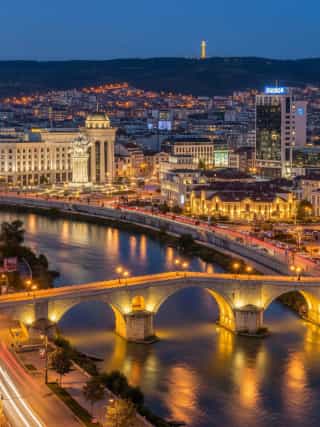
Skopje - The Capital of North Macedonia
- Population
- 584,000
- Language
- Macedonian
- Continent
- Europe
- Since
- 1991
- Eco Ranking
- 59/195
Source: Environmental Performance Index 2024.
About Skopje
Skopje has been a settlement since antiquity and served as a major city under Byzantine and later Ottoman rule for over five centuries. It became the capital of the Socialist Republic of Macedonia within Yugoslavia after World War II and has served as the capital of independent North Macedonia since 1991 when Yugoslavia began to dissolve. On 26 July 1963, a catastrophic earthquake of 6.1 magnitude destroyed approximately 80% of the city, killing over 1,000 people. Skopje was rebuilt with international assistance, including urban planning contributions from the Japanese architect Kenzō Tange. The country was renamed from the Republic of Macedonia to North Macedonia in 2019 under the Prespa Agreement with Greece, resolving a dispute that had blocked the country's NATO and EU accession for nearly three decades. Greece had objected to the use of the name 'Macedonia', which is also the name of a Greek region. North Macedonia joined NATO in 2020 and began EU accession negotiations, though formal membership remained pending.
About North Macedonia
North Macedonia is a parliamentary republic that gained independence from Yugoslavia in 1991. The country's path to Euro-Atlantic integration was blocked for decades by the name dispute with Greece, resolved by the 2019 Prespa Agreement. North Macedonia joined NATO in 2020. Its population includes a substantial Albanian minority of approximately 25%, whose political representation is a key feature of the country's governance arrangements.
View Skopje on the map
Flight time from Skopje to other capitals
| City | Distance (km) | Flight Time |
|---|---|---|
| Rome | 700 | 0h 49m |
| Paris | 1700 | 2h 0m |
| London | 1900 | 2h 14m |
| Abu Dhabi | 3600 | 4h 14m |
| Washington, D.C. | 7800 | 9h 11m |
| Cape Town | 8400 | 9h 53m |
| Tokyo | 9300 | 10h 56m |
| Singapore | 9300 | 10h 56m |
| Buenos Aires | 11800 | 13h 53m |
| Canberra | 15500 | 18h 14m |
Capitals with similar population to Skopje
| City | Population |
|---|---|
| Copenhagen | 658,390 |
| Djibouti | 623,891 |
| Riga | 614,618 |
| Vilnius | 588,412 |
| Skopje | 584,000 |
| San Salvador | 525,990 |
| Juba | 525,953 |
Capitals with similar eco ranking to Skopje
Source: Environmental Performance Index 2024.
Frequently Asked Questions
Why was the country renamed from Macedonia to North Macedonia?
The Republic of Macedonia was renamed North Macedonia in 2019 under the Prespa Agreement, a treaty signed with Greece. Greece had objected since 1991 to its northern neighbour using the name 'Macedonia', arguing it implied territorial claims over the Greek region of Macedonia. The name dispute blocked North Macedonia's accession to NATO and the EU for nearly three decades. Under the agreement, Greece dropped its objections and both countries normalised relations.
When did Skopje become the capital of North Macedonia?
Skopje became the capital of independent North Macedonia on 17 September 1991, when the country declared independence from Yugoslavia. It had previously been the capital of the Socialist Republic of Macedonia, one of Yugoslavia's constituent republics, since the reorganisation of Yugoslavia after World War II.
What happened to Skopje in 1963?
On 26 July 1963, Skopje was struck by a 6.1 magnitude earthquake that destroyed approximately 80% of the city and killed more than 1,000 people. The disaster prompted an international reconstruction effort. The urban planning of the rebuilt city was led by the Japanese architect Kenzō Tange, and many countries contributed funding and materials. The earthquake fundamentally shaped the city's modern layout.
Has North Macedonia joined the European Union?
North Macedonia began EU accession negotiations after the name dispute with Greece was resolved by the 2019 Prespa Agreement and after Bulgaria's veto over historical and linguistic disputes was lifted. The country is an EU candidate state. It joined NATO in March 2020, becoming the alliance's 30th member. Full EU membership remained pending as of 2025, with negotiations ongoing.
What is the ethnic composition of North Macedonia?
North Macedonia has a majority ethnic Macedonian population, which is predominantly Eastern Orthodox Christian. Ethnic Albanians constitute approximately 25% of the population and are predominantly Muslim. The Ohrid Framework Agreement of 2001, which ended a brief armed insurgency by ethnic Albanian groups, established power-sharing arrangements and minority rights protections that remain central to the country's political structure.
Sights and landmarks
Climate and best time to visit
Culture and customs
Economy