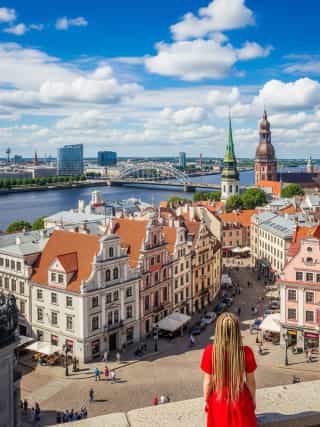
Riga - The Capital of Latvia
- Population
- 614,618
- Language
- Latvian
- Continent
- Europe
- Since
- 1991
- Eco Ranking
- 30/195
Source: Environmental Performance Index 2024.
About Riga
Founded in 1201 by the Bishop of Livonia as a base for the Christianisation of the eastern Baltic, Riga grew into the dominant commercial and political centre of the region. It passed through the control of the Livonian Order, the Polish-Lithuanian Commonwealth, Sweden, and the Russian Empire before Latvia declared independence in 1918. Riga served as capital of the interwar Latvian Republic until Soviet occupation in 1940, Nazi German occupation from 1941 to 1944, and then Soviet re-occupation until 1991. Latvia declared the restoration of independence in May 1990; it received full international recognition in August 1991 following the collapse of the Soviet coup attempt. Riga has been the largest city in the Baltic region since medieval times. Latvia joined both NATO and the European Union in 2004, cementing its Western orientation after five decades of Soviet rule. The Saeima, Latvia's parliament, and the presidency are both based in Riga's historic old city.
About Latvia
Latvia is a parliamentary republic in which the president is elected by parliament and holds a largely ceremonial role, with executive power vested in the cabinet led by the prime minister. Latvia is a member of NATO, the EU, and the eurozone, having adopted the euro in 2014. Latvia shares borders with Estonia, Lithuania, Russia, and Belarus, giving it significant geopolitical sensitivity.
View Riga on the map
Flight time from Riga to other capitals
| City | Distance (km) | Flight Time |
|---|---|---|
| London | 1700 | 2h 0m |
| Paris | 1700 | 2h 0m |
| Rome | 1900 | 2h 14m |
| Abu Dhabi | 4400 | 5h 11m |
| Washington, D.C. | 7100 | 8h 21m |
| Tokyo | 8100 | 9h 32m |
| Singapore | 9300 | 10h 56m |
| Cape Town | 10100 | 11h 53m |
| Buenos Aires | 12800 | 15h 4m |
| Canberra | 15300 | 18h 0m |
Capitals with similar population to Riga
Capitals with similar eco ranking to Riga
Source: Environmental Performance Index 2024.
Frequently Asked Questions
Why is Riga the capital of Latvia?
Riga has been the dominant city of the eastern Baltic region since its founding in 1201 and served as the administrative centre throughout successive periods of foreign rule. When Latvia declared independence in 1918, Riga was the established seat of government and remained so when independence was restored in 1991.
How long was Latvia under Soviet rule?
Latvia was under Soviet occupation from 1940 to 1941, then under Nazi German occupation from 1941 to 1944, and again under Soviet rule from 1944 until the restoration of independence in August 1991, a total of approximately 50 years of Soviet-era control. The occupation was never legally recognised by many Western states, including the United States.
When did Latvia join the European Union and NATO?
Latvia joined both NATO and the European Union in 2004. NATO membership provided the security guarantee Latvia sought after decades of Soviet occupation, and EU membership integrated the country into the European single market. Latvia adopted the euro as its currency in January 2014.
Is Riga the largest city in the Baltic states?
Yes. Riga, with a population of around 615,000, is the largest city in the three Baltic states, Latvia, Lithuania, and Estonia, and has held this distinction since medieval times when it was the most important trading city on the eastern Baltic coast. Its population has, however, declined significantly from a peak of over 900,000 during the Soviet era.
How did Latvia restore its independence in 1991?
Latvia declared the restoration of independence on 4 May 1990, framing it as a restoration of the pre-1940 republic rather than a new state. Full international recognition came on 21 August 1991, following the failed coup attempt against Mikhail Gorbachev in Moscow, which fatally weakened Soviet central authority. Latvia was among the first Soviet republics to gain full international recognition.
Sights and landmarks
Climate and best time to visit
Culture and customs
Economy