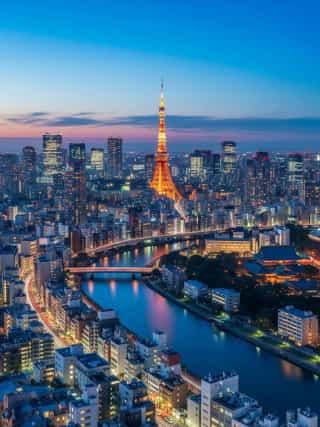
Tokyo - The Capital of Japan
- Population
- 13,960,000
- Language
- Japanese
- Continent
- Asia
- Since
- 1868
- Eco Ranking
- 27/195
Source: Environmental Performance Index 2024.
About Tokyo
Tokyo became the seat of Japan's imperial government in 1868 when Emperor Meiji moved the imperial court from Kyoto, which had been the imperial capital for over a millennium, to Edo, the seat of the Tokugawa shogunate. The city was renamed Tokyo, meaning 'Eastern Capital'. This transfer marked the end of the feudal shogunate and the beginning of Japan's rapid modernisation under the Meiji Restoration. Japan's post-World War II constitution of 1947, written under U.S. occupation, does not designate an official capital, making Tokyo technically a de facto rather than de jure capital. The Emperor is defined as 'the symbol of the State' with no governing power. Executive authority rests with the elected Prime Minister and Cabinet; the bicameral National Diet sits in central Tokyo. Japan's constitution also contains the famous Article 9, by which Japan renounces war and the maintenance of war potential, though Japan maintains significant Self-Defence Forces and has been gradually reinterpreting constitutional limits under successive governments. Tokyo was almost entirely destroyed twice in the 20th century: first by the 1923 Great Kanto Earthquake and resulting fires, which killed over 100,000 people, and again by U.S. firebombing in 1945. It was rebuilt both times. Today, greater Tokyo, encompassing the metropolitan area, is the world's largest urban agglomeration, with a population exceeding 37 million people.
About Japan
Japan is a parliamentary constitutional monarchy. The Emperor serves as a symbolic head of state with no executive power. The Prime Minister leads the government and is accountable to the National Diet, the bicameral parliament. Japan is a member of the G7 and G20 and one of the world's largest economies. Japan's constitution renounces war, though the country maintains significant Self-Defence Forces. Japan has been in a prolonged territorial dispute with China over the Senkaku/Diaoyu Islands and with Russia over the Kuril Islands.
View Tokyo on the map
Flight time from Tokyo to other capitals
| City | Distance (km) | Flight Time |
|---|---|---|
| Singapore | 5300 | 6h 14m |
| Canberra | 8000 | 9h 25m |
| Abu Dhabi | 8100 | 9h 32m |
| London | 9600 | 11h 18m |
| Paris | 9700 | 11h 25m |
| Rome | 9900 | 11h 39m |
| Washington, D.C. | 10900 | 12h 49m |
| Cape Town | 14700 | 17h 18m |
| Buenos Aires | 18400 | 21h 39m |
Capitals with similar population to Tokyo
Capitals with similar eco ranking to Tokyo
Source: Environmental Performance Index 2024.
Frequently Asked Questions
When did Tokyo become the capital of Japan?
Tokyo became the imperial capital in 1868 when Emperor Meiji relocated the court from Kyoto to Edo and renamed the city Tokyo. Kyoto had been Japan's imperial capital since 794. Tokyo's role as the seat of government has been continuous since 1868, though Japan's post-war constitution does not formally designate any official capital.
Why is Tokyo not officially designated as Japan's capital?
Japan's 1947 constitution, drafted under U.S. occupation, does not include a clause naming an official capital. No subsequent legislation has formally designated Tokyo as the capital, though the National Diet, imperial palace, and all central government ministries are located there. Tokyo functions as the capital in every practical sense; the absence of formal designation is a constitutional technicality.
What is the population of greater Tokyo?
The greater Tokyo metropolitan area has a population exceeding 37 million, making it the world's largest urban agglomeration. Tokyo Metropolis (the administrative unit governed by the Tokyo Metropolitan Government) has approximately 14 million residents. The broader metropolitan area includes the prefectures of Kanagawa, Saitama, and Chiba.
What role does the Emperor of Japan play today?
Under Japan's 1947 constitution, the Emperor is defined as 'the symbol of the State and of the unity of the People' and holds no executive, legislative, or judicial power. The Emperor performs ceremonial duties, including attesting to the appointment of the Prime Minister and the promulgation of laws passed by the National Diet. Emperor Naruhito has held the position since May 2019.
What is Article 9 of Japan's constitution?
Article 9 is the clause by which Japan renounces war as a sovereign right and the threat or use of force to settle international disputes, and pledges not to maintain war potential. Adopted in 1947, it has been interpreted to permit Self-Defence Forces for strictly defensive purposes. Successive conservative governments, particularly under Shinzo Abe, reinterpreted Article 9 to allow collective self-defence, and Japan has significantly increased defence spending in recent years.
Sights and landmarks
Climate and best time to visit
Culture and customs