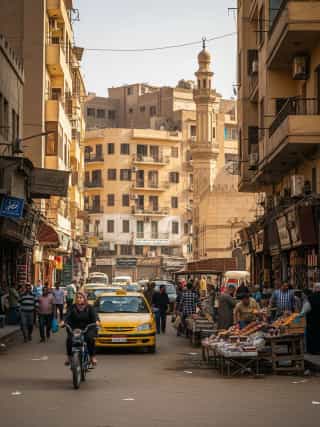
Cairo - The Capital of Egypt
- Population
- 10,230,350
- Language
- Arabic
- Continent
- Africa
- Since
- 969
- Eco Ranking
- 102/195
Source: Environmental Performance Index 2024.
About Cairo
Cairo was founded in 969 CE by the Fatimid dynasty, who established it as their imperial capital after conquering Egypt. The site was chosen north of the earlier Arab settlement of Fustat, and the city grew to become the political and religious center of a caliphate stretching across North Africa and the Levant. Under the Mamluks and later the Ottomans, Cairo remained a major administrative center. Egypt's modern capital status dates from the establishment of the Muhammad Ali dynasty in the 19th century and was consolidated under the Republic declared in 1952. Today Cairo is the seat of Egypt's presidency, government, and parliament, though Egypt began constructing a new administrative capital east of Cairo in 2015, officially named the New Administrative Capital. Several ministries and government bodies have relocated there, though the move remains incomplete. Cairo is the most populous city in both Africa and the Arab world, a fact that gives it outsized political weight in regional affairs. Egypt's constitutional framework has been reshaped multiple times since 2011.
About Egypt
Egypt is a presidential republic, though its political system has functioned with strong executive dominance throughout the modern era. The military has played a central role in governance since the 1952 revolution that ended the monarchy. Following the 2011 Arab Spring uprising and a brief period of elected civilian rule under the Muslim Brotherhood, a military-led government took power in 2013. The 2014 constitution, amended in 2019, extended presidential term limits and reinforced the military's political role.
View Cairo on the map
Flight time from Cairo to other capitals
| City | Distance (km) | Flight Time |
|---|---|---|
| Rome | 2100 | 2h 28m |
| Abu Dhabi | 2400 | 2h 49m |
| Paris | 3200 | 3h 46m |
| London | 3500 | 4h 7m |
| Cape Town | 7200 | 8h 28m |
| Singapore | 8300 | 9h 46m |
| Washington, D.C. | 9300 | 10h 56m |
| Tokyo | 9600 | 11h 18m |
| Buenos Aires | 11800 | 13h 53m |
| Canberra | 14300 | 16h 49m |
Capitals with similar population to Cairo
Capitals with similar eco ranking to Cairo
| City | Eco Rank |
|---|---|
| Mexico City | 98 |
| Montevideo | 99 |
| Windhoek | 100 |
| Dakar | 101 |
| Cairo | 102 |
| Thimphu | 103 |
| Dodoma | 104 |
Source: Environmental Performance Index 2024.
Frequently Asked Questions
When was Cairo founded and by whom?
Cairo was founded in 969 CE by the Fatimid general Jawhar al-Siqilli following the Fatimid conquest of Egypt. The city was established as the imperial capital of the Fatimid Caliphate and named al-Qahira, meaning 'the Victorious.'
Is Egypt building a new capital city?
Yes. Egypt announced plans in 2015 to build a new administrative capital approximately 45 kilometers east of Cairo. Several government ministries and state bodies have begun operating from the new city, though Cairo remains the official capital and most governmental functions are in transition.
Is Cairo the largest city in Africa?
Yes, Cairo is the most populous city in Africa, with the city proper holding over 10 million residents and the greater metropolitan area estimated at 20 million or more. It is also the largest city in the Arab world.
What role did Cairo play in the Arab Spring?
Cairo's Tahrir Square was the central location of the 2011 Egyptian uprising that forced President Hosni Mubarak to resign after nearly 30 years in power. The protests were part of the wider Arab Spring movement, and Egypt subsequently went through a turbulent period of elections, a Muslim Brotherhood presidency, and a 2013 military takeover.
Why is Cairo so politically significant in the Arab world?
Cairo is the seat of the Arab League, the regional intergovernmental organization founded in 1945, and has historically been considered the political and cultural center of the Arab world. Egypt's size, its peace treaty with Israel (1979), and its military strength make Cairo a central node in Middle Eastern diplomacy.
Sights and landmarks
Climate and best time to visit
Regional significance
Economy