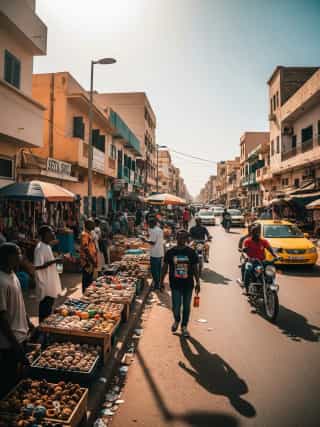
Dakar - The Capital of Senegal
- Population
- 3,732,284
- Language
- French
- Continent
- Africa
- Since
- 1960
- Eco Ranking
- 101/195
Source: Environmental Performance Index 2024.
About Dakar
Dakar became the capital of French West Africa (Afrique Occidentale Française) in 1902, making it the administrative center of a federation covering the territories of what are today Senegal, Mali, Guinea, Ivory Coast, Burkina Faso, Benin, Niger, and Mauritania. This role gave Dakar an outsized political and institutional weight that persisted well beyond the colonial era. The city occupies the Cap-Vert peninsula, the westernmost point of the African continent. Senegal achieved independence in 1960 and Dakar became its capital, retaining much of the administrative infrastructure built during the colonial period. Senegal's post-independence political history has been characterized by relative institutional stability within a challenging regional context, a civilian-led government transition occurred even as neighboring countries experienced coups. The presidency, the National Assembly, the Supreme Court, and most ministries are located in Dakar. In 2024, Bassirou Diomaye Faye was elected president following a contested political period that included the jailing of opposition leaders, marking a significant democratic transfer of power. Dakar remains one of West Africa's primary diplomatic and organizational capitals, hosting headquarters of multiple regional institutions.
About Senegal
Senegal is a presidential republic and one of West Africa's most durable multiparty democracies. The president is directly elected and holds significant executive power. The country has never experienced a military coup, a distinction shared by few countries in the West African region. Senegal is a member of ECOWAS and the African Union. It has significant offshore oil and gas reserves that began production in the mid-2020s, with the potential to alter the country's economic and political dynamics.
View Dakar on the map
Flight time from Dakar to other capitals
| City | Distance (km) | Flight Time |
|---|---|---|
| Paris | 4200 | 4h 56m |
| Rome | 4200 | 4h 56m |
| London | 4400 | 5h 11m |
| Washington, D.C. | 6400 | 7h 32m |
| Cape Town | 6600 | 7h 46m |
| Buenos Aires | 7000 | 8h 14m |
| Abu Dhabi | 7500 | 8h 49m |
| Singapore | 13300 | 15h 39m |
| Tokyo | 13900 | 16h 21m |
| Canberra | 17400 | 20h 28m |
Capitals with similar population to Dakar
| City | Population |
|---|---|
| Yaoundé | 4,164,296 |
| Amman | 4,061,150 |
| Dakar | 3,732,284 |
| Berlin | 3,669,491 |
| Abuja | 3,464,000 |
| Addis Ababa | 3,352,000 |
| Santo Domingo | 3,339,410 |
Capitals with similar eco ranking to Dakar
| City | Eco Rank |
|---|---|
| Mexico City | 98 |
| Montevideo | 99 |
| Windhoek | 100 |
| Dakar | 101 |
| Cairo | 102 |
| Thimphu | 103 |
| Dodoma | 104 |
Source: Environmental Performance Index 2024.
Frequently Asked Questions
Why was Dakar the capital of French West Africa?
Dakar was selected as the capital of French West Africa in 1902 due to its strategic location on the Cap-Vert peninsula, the westernmost point of Africa, its natural harbor, and its existing infrastructure as a colonial port. It served as the administrative, military, and commercial hub for eight modern-day West African nations under French colonial rule.
When did Dakar become the capital of independent Senegal?
Dakar became the capital of independent Senegal on 20 June 1960, when Senegal declared independence from France following the dissolution of the Mali Federation. It retained the administrative infrastructure built during the colonial period.
Has Senegal always been politically stable?
Senegal has never experienced a military coup, which distinguishes it from many of its neighbors in West Africa. Power has transferred through elections, though the process has not been without tension, opposition leaders were jailed in the years before the 2024 election, which nonetheless resulted in a peaceful transfer of power to President Bassirou Diomaye Faye.
Is Dakar the largest city in Senegal?
Yes, Dakar is by far the largest city in Senegal, with a metropolitan population of approximately 3.7 million out of Senegal's total population of around 17 million. It accounts for a disproportionate share of the country's economic output and government employment.
What regional institutions are headquartered in Dakar?
Dakar hosts the headquarters of several regional bodies, including the African Development Bank's West Africa Regional Office and UEMOA (the West African Economic and Monetary Union) observer offices, as well as multiple UN agencies. Its legacy as the colonial capital of French West Africa gave it an institutional concentration that other capitals in the region lack.
Sights and landmarks
Climate and best time to visit
Culture and customs
Economy