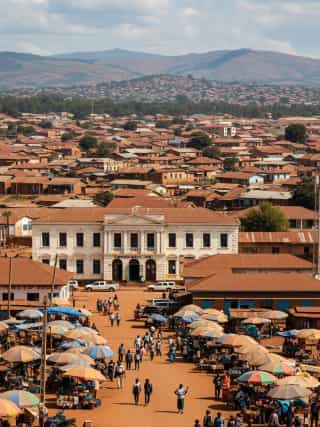
Gitega - The Capital of Burundi
- Population
- 135,467
- Language
- Kirundi
- Continent
- Africa
- Since
- 2019
- Eco Ranking
- 162/195
Source: Environmental Performance Index 2024.
About Gitega
Gitega became Burundi's official capital in January 2019, making it one of the most recently designated national capitals in the world. The decision to relocate the capital from Bujumbura was a deliberate political act by President Pierre Nkurunziza, who sought to shift the center of state power away from the country's largest city, which had historically been the seat of political opposition and urban unrest, toward the interior of the country. Gitega, located roughly 100 kilometers east of Bujumbura, had served as the royal capital of the Kingdom of Burundi before Belgian colonization, giving the move a symbolic dimension as well as a political one. The government transferred administrative functions, including key ministries, to Gitega, though Bujumbura retains its status as the country's economic and commercial hub. The relocation came in the aftermath of Burundi's 2015 political crisis, triggered when Nkurunziza announced he would seek a constitutionally disputed third term, leading to protests, a coup attempt, and widespread violence. Gitega remains underdeveloped relative to Bujumbura in terms of infrastructure and services. It is the seat of the National Assembly and the presidency.
About Burundi
Burundi is a landlocked republic in Central Africa governed under a presidential system. It is one of the world's poorest and most densely populated countries. Political power has been marked by repeated instability since independence from Belgium in 1962, including ethnically charged conflicts between Hutu and Tutsi populations. The 2015 political crisis and its aftermath drove over 400,000 Burundians into exile. President Nkurunziza died in 2020 and was succeeded by Evariste Ndayishimiye.
View Gitega on the map
Flight time from Gitega to other capitals
| City | Distance (km) | Flight Time |
|---|---|---|
| Cape Town | 3600 | 4h 14m |
| Abu Dhabi | 4100 | 4h 49m |
| Rome | 5300 | 6h 14m |
| Paris | 6400 | 7h 32m |
| London | 6700 | 7h 53m |
| Singapore | 8200 | 9h 39m |
| Buenos Aires | 9600 | 11h 18m |
| Washington, D.C. | 11700 | 13h 46m |
| Tokyo | 12000 | 14h 7m |
| Canberra | 12400 | 14h 35m |
Capitals with similar population to Gitega
| City | Population |
|---|---|
| Port Louis | 149,194 |
| Gitega | 135,467 |
| Bern | 133,883 |
| Reykjavik | 131,136 |
| Luxembourg City | 128,514 |
| Georgetown | 118,363 |
| Sri Jayawardenepura Kotte | 115,826 |
Capitals with similar eco ranking to Gitega
Source: Environmental Performance Index 2024.
Frequently Asked Questions
When did Gitega become the capital of Burundi?
Gitega was officially designated the capital of Burundi in January 2019, when the government of President Pierre Nkurunziza announced the transfer of the capital from Bujumbura. The formal move of government institutions followed over subsequent months.
Why did Burundi move its capital from Bujumbura to Gitega?
The move was a political decision by President Nkurunziza to shift power away from Bujumbura, which had been a center of opposition to his rule during the 2015 crisis. Gitega, located in the interior, was seen as more politically neutral and had historical significance as the former royal capital of the Kingdom of Burundi.
What is the difference between Gitega and Bujumbura today?
Gitega is the official political capital, housing the presidency and key government ministries. Bujumbura remains the largest city and the country's economic and commercial center, and is significantly more developed in terms of infrastructure.
Was Gitega always an important city in Burundi?
Yes. Gitega served as the royal capital of the Kingdom of Burundi before Belgian colonization, giving it historical and cultural significance. However, after independence in 1962, Bujumbura, the former colonial capital, remained the political center until 2019.
Is Gitega the largest city in Burundi?
No. Bujumbura, the former capital, is by far the largest city in Burundi with a population well over 1 million. Gitega has a population of approximately 135,000, making it the second-largest city in the country.
Sights and landmarks
Climate and best time to visit
Culture and customs
Economy