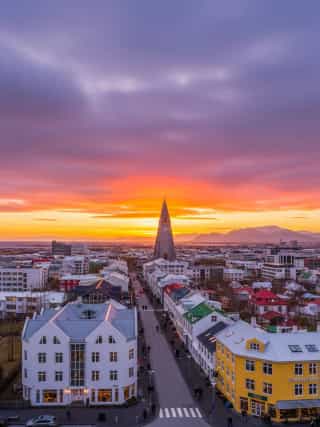
Reykjavik - The Capital of Iceland
- Population
- 131,136
- Language
- Icelandic
- Continent
- Europe
- Since
- 1786
- Eco Ranking
- 19/195
Source: Environmental Performance Index 2024.
About Reykjavik
Reykjavik received its municipal charter in 1786, though human settlement in the area dates to the 9th century, making it one of the earliest sites of Norse habitation in Iceland. For most of Iceland's history under Danish rule, Reykjavik was a minor trading post; its political significance grew as Iceland moved toward self-governance. The Althing, the world's oldest parliament (established 930 CE), was relocated to Reykjavik in 1844. Iceland achieved home rule in 1904, became a sovereign kingdom in personal union with Denmark in 1918, and declared a republic in 1944 while Denmark was under German occupation. Reykjavik is the northernmost capital of any sovereign state in the world. The city houses the Althing, the office of the president, and the principal government ministries. Iceland became the first country to have a democratically elected female head of government when Vigdís Finnbogadóttir was elected president in 1980, serving until 1996.
About Iceland
Iceland is a parliamentary republic with a largely ceremonial president and an executive prime minister accountable to the Althing. It is a founding member of NATO but is not a member of the European Union, though it participates in the European single market through the European Economic Area. Iceland has no standing army, relying on NATO's collective defence framework.
View Reykjavik on the map
Flight time from Reykjavik to other capitals
| City | Distance (km) | Flight Time |
|---|---|---|
| London | 1900 | 2h 14m |
| Paris | 2200 | 2h 35m |
| Rome | 3300 | 3h 53m |
| Washington, D.C. | 4500 | 5h 18m |
| Abu Dhabi | 6900 | 8h 7m |
| Tokyo | 8800 | 10h 21m |
| Buenos Aires | 11400 | 13h 25m |
| Cape Town | 11500 | 13h 32m |
| Singapore | 11500 | 13h 32m |
| Canberra | 16800 | 19h 46m |
Capitals with similar population to Reykjavik
| City | Population |
|---|---|
| Gitega | 135,467 |
| Bern | 133,883 |
| Reykjavik | 131,136 |
| Luxembourg City | 128,514 |
| Georgetown | 118,363 |
| Sri Jayawardenepura Kotte | 115,826 |
| Thimphu | 115,000 |
Capitals with similar eco ranking to Reykjavik
Source: Environmental Performance Index 2024.
Frequently Asked Questions
Why is Reykjavik the capital of Iceland?
Reykjavik developed as Iceland's administrative and commercial centre during Danish rule, and the Althing, Iceland's parliament, was relocated there in 1844. When Iceland gained increasing autonomy and eventually declared independence, Reykjavik's established role as the seat of government made it the natural capital. Today it houses all major branches of government.
Is Reykjavik the northernmost capital in the world?
Yes. Reykjavik, at approximately 64°N latitude, is the northernmost capital of any sovereign state in the world. It sits just south of the Arctic Circle. While some territories and autonomous regions have more northerly administrative centres, no fully independent sovereign state has its capital further north.
What share of Iceland's population lives in Reykjavik?
Roughly two-thirds of Iceland's total population of around 370,000 live in the greater Reykjavik capital region, which includes surrounding municipalities. The city proper has about 131,000 residents. This concentration reflects Iceland's status as one of the most urbanised, and most sparsely populated overall, countries in Europe.
When did Iceland become an independent republic?
Iceland declared itself a republic on 17 June 1944, dissolving its union with Denmark. The declaration came while Denmark was occupied by Nazi Germany, effectively ending the Danish Crown's role in Icelandic governance. Iceland had been a sovereign kingdom in personal union with Denmark since 1918, and before that under Danish rule since the 14th century.
What is the Althing and why is it significant?
The Althing is Iceland's national parliament, first established in 930 CE at Þingvellir, making it one of the world's oldest representative assemblies. It was suspended under Danish rule but re-established in 1844 in Reykjavik. Today it functions as Iceland's unicameral legislature, with 63 members elected by proportional representation.
Sights and landmarks
Climate and best time to visit
Regional significance
Culture and customs
Economy