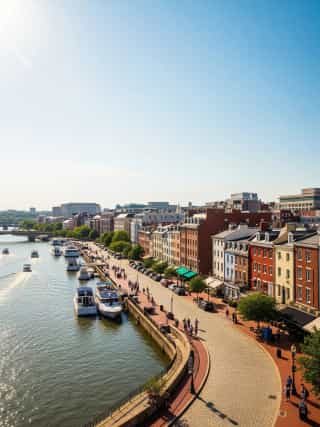
Georgetown - The Capital of Guyana
- Population
- 118,363
- Language
- English
- Continent
- South America
- Since
- 1781
- Eco Ranking
- 71/195
Source: Environmental Performance Index 2024.
About Georgetown
Georgetown was founded by the Dutch in 1781 on land at the mouth of the Demerara River, and was initially called Stabroek. Following a series of colonial transfers between Dutch and British control, Britain formally took possession of the territory in 1814, and the city was renamed Georgetown in honor of King George III. It became the capital of British Guiana and, upon independence in 1966, of Guyana. A defining physical characteristic of the city is that it sits below sea level, protected by a sea wall and an elaborate drainage infrastructure originally designed and built by Dutch colonial engineers. Without continuous maintenance of these systems, large parts of the city would flood. Guyana is the only English-speaking country in South America, a legacy of British colonial rule that sets it apart from all its neighbors. Georgetown houses the National Assembly, the offices of the presidency, and the Supreme Court. Since the discovery of offshore oil in 2015 and the start of production in 2019, Guyana's government has been managing one of the world's fastest-growing oil revenues, with significant policy decisions concentrated in the capital.
About Guyana
Guyana is a republic on the northeastern coast of South America, governed under a parliamentary system with a directly elected executive president. It is the only English-speaking nation on the South American mainland, bordered by Venezuela, Brazil, and Suriname. Guyana became independent from Britain in 1966. The 2015 discovery of substantial offshore oil reserves has made it one of the fastest-growing economies in the world, fundamentally altering its political and fiscal landscape.
View Georgetown on the map
Flight time from Georgetown to other capitals
| City | Distance (km) | Flight Time |
|---|---|---|
| Washington, D.C. | 4000 | 4h 42m |
| Buenos Aires | 4600 | 5h 25m |
| London | 7200 | 8h 28m |
| Paris | 7300 | 8h 35m |
| Rome | 7900 | 9h 18m |
| Cape Town | 9200 | 10h 49m |
| Abu Dhabi | 11900 | 14h 0m |
| Tokyo | 14900 | 17h 32m |
| Canberra | 15800 | 18h 35m |
| Singapore | 17800 | 20h 56m |
Capitals with similar population to Georgetown
| City | Population |
|---|---|
| Bern | 133,883 |
| Reykjavik | 131,136 |
| Luxembourg City | 128,514 |
| Georgetown | 118,363 |
| Sri Jayawardenepura Kotte | 115,826 |
| Thimphu | 115,000 |
| Bridgetown | 110,000 |
Capitals with similar eco ranking to Georgetown
Source: Environmental Performance Index 2024.
Frequently Asked Questions
Why is Georgetown below sea level?
Georgetown was built on low-lying coastal land that sits roughly 1.5 metres below the high-tide mark. Dutch colonizers constructed a system of sea walls, canals, and drainage pumps to make the land habitable. These Dutch-engineered drainage systems remain essential to the city's survival today.
When did Georgetown become the capital of Guyana?
Georgetown served as the capital of British Guiana throughout the colonial period and transitioned directly to being the capital of independent Guyana on May 26, 1966, when the country gained independence from Britain.
Who founded Georgetown?
Georgetown was founded by Dutch colonizers in 1781 under the name Stabroek. The British renamed it Georgetown after taking control of the territory, a change that was formalized following Britain's permanent acquisition of the colony in 1814.
Is Guyana the only English-speaking country in South America?
Yes, Guyana is the only sovereign nation in South America where English is the official language, a legacy of British colonial rule. Its neighbors, Venezuela, Brazil, and Suriname, use Spanish, Portuguese, and Dutch respectively.
What is the political system of Guyana and how does Georgetown function as its capital?
Guyana operates as a republic with a directly elected executive president and a unicameral National Assembly. Georgetown hosts all major branches of government, including the parliament building, the Office of the President, and the Supreme Court of Judicature.
Sights and landmarks
Climate and best time to visit
Regional significance
Economy