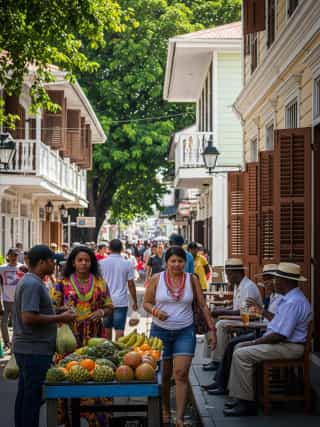
Paramaribo - The Capital of Suriname
- Population
- 240,924
- Language
- Dutch
- Continent
- South America
- Since
- 1975
- Eco Ranking
- 36/195
Source: Environmental Performance Index 2024.
About Paramaribo
Paramaribo is the capital of South America's only Dutch-speaking country, a legacy of Suriname's three centuries as a Dutch colony. The Dutch acquired the territory in 1667 in exchange for New Amsterdam, present-day New York, under the Treaty of Breda, a trade that has defined Suriname's colonial identity. The city served as the administrative hub of a plantation economy dependent on enslaved and, later, indentured labor brought from Africa, India, Java, and China, producing a population of extraordinary ethnic complexity. Suriname gained independence from the Netherlands in November 1975. Five years later, a military coup led by Sergeant Dési Bouterse overthrew the elected government, inaugurating a period of authoritarian rule marked by the 1982 December Murders, in which fifteen political opponents were executed. Bouterse returned to power through democratic elections as president from 2010 to 2020. In 2019, a Surinamese court sentenced him in absentia to 20 years in prison for his role in the December Murders, while he was still president. The historic inner city of Paramaribo is a UNESCO World Heritage Site, recognized for its Dutch colonial architecture. Suriname's economy depends heavily on gold mining and oil, and the country has faced significant fiscal crises in recent years.
About Suriname
Suriname is a presidential republic and the smallest sovereign state in South America by area. The unicameral National Assembly holds 51 seats. Suriname maintains close ties with the Netherlands, and Dutch is the sole official language. The country is one of the most ethnically diverse nations in the Americas, a direct product of colonial labor migration from multiple continents.
View Paramaribo on the map
Flight time from Paramaribo to other capitals
| City | Distance (km) | Flight Time |
|---|---|---|
| Washington, D.C. | 4300 | 5h 4m |
| Buenos Aires | 4500 | 5h 18m |
| London | 7100 | 8h 21m |
| Paris | 7200 | 8h 28m |
| Rome | 7700 | 9h 4m |
| Cape Town | 8900 | 10h 28m |
| Abu Dhabi | 11700 | 13h 46m |
| Tokyo | 15100 | 17h 46m |
| Canberra | 15900 | 18h 42m |
| Singapore | 17600 | 20h 42m |
Capitals with similar population to Paramaribo
| City | Population |
|---|---|
| Dili | 277,279 |
| Nassau | 274,400 |
| Porto-Novo | 264,320 |
| Gaborone | 246,325 |
| Paramaribo | 240,924 |
| Malé | 227,486 |
| Wellington | 215,800 |
Capitals with similar eco ranking to Paramaribo
| City | Eco Rank |
|---|---|
| Bucharest | 34 |
| Wellington | 34 |
| Washington, D.C. | 35 |
| Paramaribo | 36 |
| Sofia | 37 |
| Nassau | 38 |
| St. John's | 39 |
Source: Environmental Performance Index 2024.
Frequently Asked Questions
Why does Suriname speak Dutch?
Suriname was a Dutch colony from 1667 until independence in 1975. The Dutch acquired the territory from England under the Treaty of Breda in 1667. Dutch was established as the administrative and official language during colonial rule and remains the official language of the independent state today.
What were the December Murders in Suriname?
The December Murders refers to the execution of fifteen prominent Surinamese intellectuals, journalists, lawyers, and military officers on December 8, 1982, by the military government of Dési Bouterse. The killings drew international condemnation and resulted in the Netherlands suspending development aid. Bouterse was convicted for these murders by a Surinamese military tribunal in 2019.
When did Suriname gain independence?
Suriname gained independence from the Netherlands on November 25, 1975. A significant portion of the Surinamese population emigrated to the Netherlands before independence, anticipating economic difficulties. The country experienced a military coup just five years after independence in 1980.
Why is Paramaribo a UNESCO World Heritage Site?
The historic inner city of Paramaribo was inscribed as a UNESCO World Heritage Site in 2002 for its outstanding example of Dutch colonial plantation town planning and architecture. The site features a distinctive blend of European building styles adapted to tropical conditions over three centuries.
Is Suriname considered part of South America or the Caribbean?
Suriname is geographically located on the northeastern coast of South America and is considered part of the South American continent. However, it is also a member of the Caribbean Community (CARICOM) and shares cultural and historical ties with the Caribbean. It is the only Dutch-speaking country in South America.
Sights and landmarks
Climate and best time to visit
Culture and customs
Economy