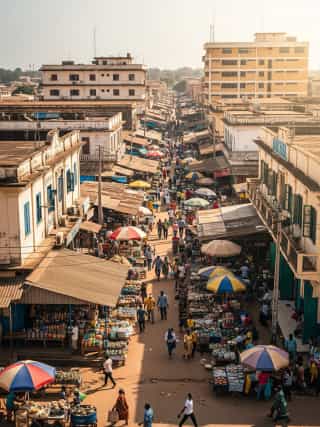
Porto-Novo - The Capital of Benin
- Population
- 264,320
- Language
- French
- Continent
- Africa
- Since
- 1730
- Eco Ranking
- 141/195
Source: Environmental Performance Index 2024.
About Porto-Novo
Porto-Novo is the constitutional capital of Benin, but this designation tells only part of the story. In practice, the country operates with a split capital arrangement: Porto-Novo holds formal constitutional status as the capital and is home to the National Assembly, but the seat of the executive government, the presidency, and most ministries are located in Cotonou, the country's largest city and economic center, located some 30 kilometers to the west. Nearly all foreign embassies are also accredited to Cotonou rather than Porto-Novo. This arrangement has been in place since independence from France in 1960 and reflects the economic and demographic dominance of Cotonou. Porto-Novo's history as a capital predates colonialism: it was the seat of the Kingdom of Porto-Novo, a Yoruba-influenced polity that established ties with the Portuguese in the 16th century, giving the city its Portuguese name. The city was later absorbed into the French colonial orbit in the late 19th century. Benin, formerly called Dahomey until 1975, has been considered one of West Africa's more functional democracies since its 1990 democratic transition, though President Patrice Talon's administration has been criticized for restricting political opposition since 2016. Porto-Novo's status as nominal capital with limited governmental function makes it one of Africa's clearest examples of de jure and de facto capital divergence.
About Benin
Benin is a presidential republic in West Africa. Porto-Novo is the constitutional capital; Cotonou functions as the de facto governmental and economic center. Benin is notably recognized for its 1990 democratic transition, a peaceful shift from a Marxist-Leninist single-party state to multi-party democracy, which was influential across francophone Africa. The country borders Togo, Burkina Faso, Niger, and Nigeria.
View Porto-Novo on the map
Flight time from Porto-Novo to other capitals
| City | Distance (km) | Flight Time |
|---|---|---|
| Rome | 4100 | 4h 49m |
| Paris | 4700 | 5h 32m |
| Cape Town | 4800 | 5h 39m |
| London | 5000 | 5h 53m |
| Abu Dhabi | 5900 | 6h 56m |
| Buenos Aires | 7900 | 9h 18m |
| Washington, D.C. | 8700 | 10h 14m |
| Singapore | 11200 | 13h 11m |
| Tokyo | 13500 | 15h 53m |
| Canberra | 15300 | 18h 0m |
Capitals with similar population to Porto-Novo
Capitals with similar eco ranking to Porto-Novo
Source: Environmental Performance Index 2024.
Frequently Asked Questions
Why does Benin have two capitals?
Benin has a split capital: Porto-Novo is the constitutional capital and seat of the legislature, while Cotonou serves as the de facto capital where the executive government, most ministries, and foreign embassies are located. This arrangement emerged at independence in 1960 and reflects Cotonou's greater size, economic importance, and infrastructure.
Is Porto-Novo or Cotonou the real capital of Benin?
Porto-Novo is the legally designated capital under Benin's constitution and hosts the National Assembly. However, Cotonou functions as the operational center of government, housing the presidency, most ministries, and the diplomatic community. Both cities are considered capitals in different senses.
When did Benin gain independence?
Benin, then known as Dahomey, gained independence from France on August 1, 1960. The country was renamed Benin in 1975 during the Marxist-Leninist regime of Mathieu Kérékou, taking the name from the Bight of Benin.
What was the significance of Benin's 1990 democratic transition?
Benin's 1990 transition was one of the first peaceful shifts from a single-party Marxist state to multiparty democracy in sub-Saharan Africa. A national conference forced President Kérékou to accept political reforms, a new constitution, and multiparty elections, a model that was closely watched and partially replicated across francophone Africa.
What is the historical origin of Porto-Novo?
Porto-Novo developed as the seat of a pre-colonial Yoruba-influenced kingdom that established trade contact with Portuguese merchants in the 16th century, from whom it received its Portuguese name meaning 'New Port.' The city later became a center of the Atlantic slave trade before French colonial administration formalized it as the colonial capital of Dahomey.
Sights and landmarks
Culture and customs
Economy