Sucre - The Capital of Bolivia
- Population
- 280,585
- Language
- Spanish
- Continent
- South America
- Since
- 1538
- Eco Ranking
- 93/195
Source: Environmental Performance Index 2024.
About Sucre
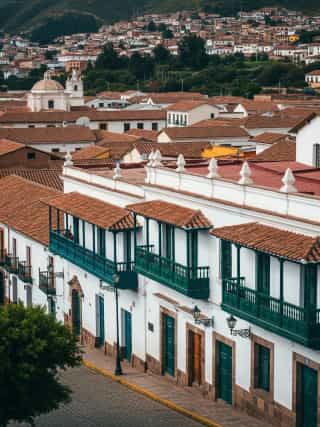
Sucre holds the distinction of being Bolivia's constitutional capital, the only city formally designated as the capital in Bolivia's constitution, and the seat of the Supreme Court. Its foundational role in Bolivian statehood is unambiguous: the country's declaration of independence was signed here in 1825, and the city was named after Antonio José de Sucre, the Venezuelan general who commanded the decisive military campaign that secured independence from Spain. Despite this constitutional status, Sucre has not been the seat of Bolivia's executive or legislative government since 1899, when a civil war between Sucre-based conservatives and La Paz-backed liberals ended in liberal victory. The government and parliament transferred to La Paz, where they have remained ever since. Bolivia's arrangement is unique among the world's dual-capital systems: the constitutional capital is not where the government governs, and the de facto capital is not named as such in the constitution. Sucre retains the judicial branch and the constitutional designation, while La Paz holds the presidency, cabinet, and National Assembly. Attempts to return full capital status to Sucre resurfaced during the 2006-2009 constitutional assembly process but were ultimately rejected, provoking significant political unrest. The city sits at approximately 2,750 metres above sea level and is recognised for its well-preserved colonial architecture.
About Bolivia
Bolivia is a plurinational state under a 2009 constitution that formally recognised the country's indigenous majority and restructured the state. The President holds strong executive authority. Bolivia is one of the poorest countries in South America but holds significant reserves of lithium, natural gas, and minerals. The country has experienced repeated political crises, including a contested 2019 election that led to the resignation of President Evo Morales and a period of political turmoil.
View Sucre on the map
Flight time from Sucre to other capitals
| City | Distance (km) | Flight Time |
|---|---|---|
| Buenos Aires | 1900 | 2h 14m |
| Washington, D.C. | 6600 | 7h 46m |
| Cape Town | 8300 | 9h 46m |
| London | 10100 | 11h 53m |
| Paris | 10100 | 11h 53m |
| Rome | 10400 | 12h 14m |
| Canberra | 13000 | 15h 18m |
| Abu Dhabi | 13800 | 16h 14m |
| Tokyo | 16900 | 19h 53m |
| Singapore | 17700 | 20h 49m |
Capitals with similar population to Sucre
| City | Population |
|---|---|
| Ciudad de la Paz | 297,000 |
| Ljubljana | 295,504 |
| Sucre | 280,585 |
| Dili | 277,279 |
| Nassau | 274,400 |
| Porto-Novo | 264,320 |
| Gaborone | 246,325 |
Capitals with similar eco ranking to Sucre
Source: Environmental Performance Index 2024.
Frequently Asked Questions
Why does Bolivia have two capitals?
Bolivia's dual-capital arrangement stems from a civil war in 1899. Conservative forces based in Sucre lost to liberal forces backed by La Paz, and the seat of government transferred to La Paz as a consequence. Sucre retained constitutional capital status and the Supreme Court. No subsequent government successfully reversed this arrangement.
What is the difference between Sucre and La Paz in Bolivia's government?
Sucre is Bolivia's constitutional capital and houses the Supreme Court of Justice. La Paz is the seat of the executive branch (presidency and cabinet) and the legislative branch (National Assembly). This makes La Paz the functional capital for most governmental purposes, despite Sucre's constitutional designation.
Who was Antonio José de Sucre?
Antonio José de Sucre was a Venezuelan-born general who played a decisive role in South American independence movements. He commanded the forces that defeated the Spanish at the Battle of Ayacucho in 1824 and became the first president of Bolivia. The city of Sucre was renamed in his honour after independence.
When did Sucre become Bolivia's capital?
Sucre, then called Chuquisaca, served as the seat of a Spanish colonial audiencia from 1559 and became the capital of independent Bolivia in 1825. Bolivia's declaration of independence was signed there. It lost the seat of government to La Paz in 1899 following the civil war but retained constitutional capital status.
Is Sucre the largest city in Bolivia?
No. Sucre has a population of approximately 280,000, making it significantly smaller than La Paz (around 1.8 million in the greater metropolitan area) and Santa Cruz, which is Bolivia's largest city with over 2 million people. Sucre's political and judicial role is therefore disproportionate to its size.
Sights and landmarks
Climate and best time to visit
Culture and customs
Economy