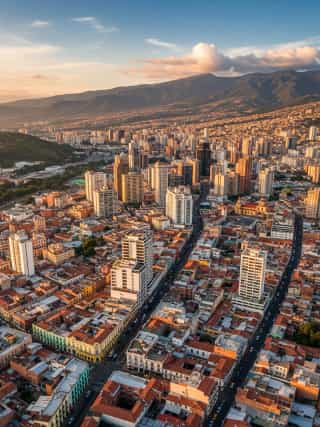
Caracas - The Capital of Venezuela
- Population
- 2,935,744
- Language
- Spanish
- Continent
- South America
- Since
- 1577
- Eco Ranking
- 45/195
Source: Environmental Performance Index 2024.
About Caracas
Caracas was founded as a Spanish colonial settlement in 1567 and became the capital of the Captaincy General of Venezuela in 1777. Its political significance extends well beyond Venezuela: it was the birthplace of Simón Bolívar (1783), the military leader who led independence movements across Venezuela, Colombia, Ecuador, Peru, and Bolivia. After Venezuelan independence in 1821, Caracas became the capital of the successive states through which Venezuela's political identity formed. The discovery of oil in the early 20th century transformed the country's economy and concentrated wealth and power in the capital. Under Hugo Chávez, who took office in 1999, Caracas became the center of the Bolivarian Revolution, a socialist political project that reshaped the Venezuelan state, nationalized industries, and positioned Venezuela in opposition to U.S. foreign policy in Latin America. Under Nicolás Maduro, who succeeded Chávez in 2013, Venezuela descended into severe economic and political crisis, producing one of the largest displacement crises in the Western Hemisphere, with over seven million Venezuelans emigrating by the mid-2020s. Caracas remains one of the most violent capitals in the world by homicide rate.
About Venezuela
Venezuela is formally a federal presidential republic, though its democratic institutions have been systematically weakened since 1999. The Maduro government has been widely characterized as authoritarian by international observers, particularly following the disputed 2024 presidential election. Venezuela holds among the world's largest proven oil reserves, concentrated in the Orinoco Belt. The country's economy collapsed following the fall in oil prices combined with mismanagement, leading to hyperinflation and a humanitarian crisis recognized by international agencies.
View Caracas on the map
Flight time from Caracas to other capitals
| City | Distance (km) | Flight Time |
|---|---|---|
| Washington, D.C. | 3300 | 3h 53m |
| Buenos Aires | 5100 | 6h 0m |
| London | 7500 | 8h 49m |
| Paris | 7600 | 8h 56m |
| Rome | 8400 | 9h 53m |
| Cape Town | 10200 | 12h 0m |
| Abu Dhabi | 12600 | 14h 49m |
| Tokyo | 14200 | 16h 42m |
| Canberra | 15500 | 18h 14m |
| Singapore | 18300 | 21h 32m |
Capitals with similar population to Caracas
| City | Population |
|---|---|
| Lisbon | 2,963,929 |
| Kyiv | 2,962,180 |
| Sana'a | 2,961,837 |
| Caracas | 2,935,744 |
| Guatemala City | 2,918,337 |
| Tashkent | 2,906,000 |
| Buenos Aires | 2,890,151 |
Capitals with similar eco ranking to Caracas
| City | Eco Rank |
|---|---|
| Kingstown | 42 |
| Nicosia | 44 |
| Libreville | 45 |
| Caracas | 45 |
| Bridgetown | 46 |
| Brasília | 47 |
| Singapore | 47 |
Source: Environmental Performance Index 2024.
Frequently Asked Questions
Why is Caracas historically significant in South American independence history?
Caracas was the birthplace of Simón Bolívar, born on 24 July 1783. Bolívar led the military campaigns that liberated Venezuela, Colombia, Ecuador, Peru, and Bolivia from Spanish rule, making Caracas the symbolic origin point of South American independence.
When did Caracas become the capital of Venezuela?
Caracas has been the political center of Venezuela since the colonial period, formally serving as capital of the Captaincy General of Venezuela from 1777. After independence in 1821, it became the capital of Gran Colombia and subsequently of Venezuela when it separated in 1830.
Is Caracas still the seat of the Venezuelan government?
Yes. Caracas remains the seat of all branches of the Venezuelan government, including the presidency, the National Assembly, and the Supreme Court. The government of Nicolás Maduro continues to operate from Caracas despite international non-recognition of his 2024 re-election by many countries.
Is Caracas the largest city in Venezuela?
Yes, Caracas is the largest city in Venezuela, with a metropolitan population of approximately 3 million in the city proper and around 5 million in the greater capital district area. It is home to the country's main governmental, financial, and media institutions.
How has the Venezuelan political crisis affected Caracas?
Since approximately 2014, Caracas has experienced severe deterioration in public services, infrastructure, and security as Venezuela's economic collapse deepened. The city has one of the highest homicide rates of any capital in the world. Over seven million Venezuelans had emigrated by the mid-2020s, and Caracas has seen significant population decline.
Sights and landmarks
Climate and best time to visit
Culture and customs
Economy