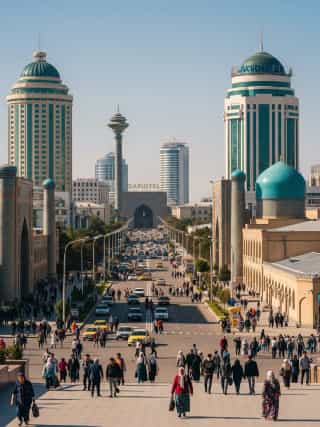
Tashkent - The Capital of Uzbekistan
- Population
- 2,906,000
- Language
- Uzbek
- Continent
- Asia
- Since
- 1991
- Eco Ranking
- 109/195
Source: Environmental Performance Index 2024.
About Tashkent
Tashkent became the capital of the Republic of Uzbekistan upon the dissolution of the Soviet Union in 1991, having previously served as the capital of the Uzbek Soviet Socialist Republic since 1930. Under Soviet rule, it was the largest city in Central Asia and functioned as the administrative and cultural hub of the entire region. A devastating earthquake in 1966 destroyed much of the historic city, prompting a Soviet-led reconstruction that reshaped Tashkent into a modernist Soviet urban centre, erasing much of its pre-Soviet architectural heritage. The post-Soviet political history of Tashkent and Uzbekistan was dominated by Islam Karimov, who led the country from 1989 as Communist Party First Secretary and then as president following independence. Karimov maintained power until his death in 2016, presiding over one of the most repressive governments in the post-Soviet space, systematic torture, suppression of political opposition, forced labour in cotton harvests, and the violent suppression of protests in Andijan in 2005, in which hundreds were killed. His successor, Shavkat Mirziyoyev, introduced selective reforms while maintaining authoritarian control. Tashkent houses the presidency, parliament, and government ministries, and has undergone significant urban redevelopment. With a population approaching 3 million, it remains by far the largest city in Central Asia and the political nerve centre of a country of strategic importance given its position between Russia, China, and Afghanistan.
About Uzbekistan
Uzbekistan is a presidential republic in which the president holds dominant executive authority. Shavkat Mirziyoyev has governed since 2016, introducing economic reforms and a more open foreign policy than his predecessor while maintaining tight political control. Uzbekistan is one of only two doubly landlocked countries in Central Asia and is a significant producer of natural gas, gold, and cotton. The country has a population of approximately 36 million.
View Tashkent on the map
Flight time from Tashkent to other capitals
| City | Distance (km) | Flight Time |
|---|---|---|
| Abu Dhabi | 2300 | 2h 42m |
| Rome | 4600 | 5h 25m |
| Paris | 5100 | 6h 0m |
| London | 5200 | 6h 7m |
| Singapore | 5600 | 6h 35m |
| Tokyo | 6000 | 7h 4m |
| Cape Town | 9800 | 11h 32m |
| Washington, D.C. | 10500 | 12h 21m |
| Canberra | 11800 | 13h 53m |
| Buenos Aires | 15400 | 18h 7m |
Capitals with similar population to Tashkent
| City | Population |
|---|---|
| Kyiv | 2,962,180 |
| Sana'a | 2,961,837 |
| Caracas | 2,935,744 |
| Guatemala City | 2,918,337 |
| Tashkent | 2,906,000 |
| Buenos Aires | 2,890,151 |
| Rome | 2,873,494 |
Capitals with similar eco ranking to Tashkent
Source: Environmental Performance Index 2024.
Frequently Asked Questions
When did Tashkent become the capital of Uzbekistan?
Tashkent has been the capital of the Uzbek Soviet Socialist Republic since 1930 and became the capital of independent Uzbekistan in 1991 following the collapse of the Soviet Union. Before Soviet rule, Tashkent was an important centre of trade and Islamic scholarship along the Silk Road. A 1966 earthquake destroyed large parts of the pre-Soviet city.
What was the 1966 Tashkent earthquake?
A major earthquake struck Tashkent on 26 April 1966, destroying approximately 70,000 buildings and leaving around 300,000 people homeless. The Soviet government launched a major reconstruction effort, rebuilding the city with standardised Soviet-era apartment blocks and wide boulevards. The reconstruction replaced much of Tashkent's historic architecture with modernist Soviet urban planning.
Who was Islam Karimov?
Islam Karimov ruled Uzbekistan from 1989 to his death in 2016, first as Communist Party leader and then as president. His government was widely condemned for systematic human rights abuses, including torture of political prisoners, suppression of religious groups, and the violent crackdown on protests in Andijan in 2005. He was one of the longest-serving leaders in the post-Soviet space.
Is Tashkent the largest city in Central Asia?
Yes. Tashkent is the largest city in Central Asia, with a population of approximately 2.9 million in the city proper and over 3.5 million in the greater metropolitan area. It significantly exceeds the next largest Central Asian cities in size and serves as the primary economic, cultural, and political centre of the region.
What is Uzbekistan's political system?
Uzbekistan is formally a presidential republic with a bicameral legislature, but in practice it operates as an authoritarian state. The president holds dominant executive power. Shavkat Mirziyoyev succeeded Islam Karimov in 2016 and has introduced limited economic and social reforms while maintaining tight control over political opposition, media, and civil society.
Sights and landmarks
Climate and best time to visit
Regional significance
Culture and customs