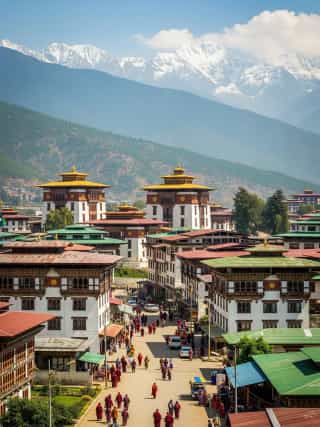
Thimphu - The Capital of Bhutan
- Population
- 115,000
- Language
- Dzongkha
- Continent
- Asia
- Since
- 1961
- Eco Ranking
- 103/195
Source: Environmental Performance Index 2024.
About Thimphu
Thimphu has served as the capital of Bhutan since 1961, when King Jigme Dorji Wangchuck designated it the permanent seat of government, replacing the former winter capital of Punakha. The decision reflected a broader programme of cautious modernisation under royal direction. Situated in the Wang Chhu river valley at approximately 2,300 metres above sea level, Thimphu is one of the highest national capitals in Asia. Bhutan is a constitutional monarchy established formally by the 2008 constitution, which transformed the country from an absolute monarchy into a parliamentary system. The King, holding the title Druk Gyalpo (Dragon King), remains head of state and retains significant constitutional authority, including the power to dissolve parliament and return authority to the electorate. The prime minister leads the elected government. Bhutan governed itself in near-total isolation for much of the 20th century, television and the internet were only permitted in 1999, making Bhutan one of the last countries in the world to permit both. The country's approach to development is formally guided by the concept of Gross National Happiness (GNH), an official policy metric adopted as an alternative framework to GDP-focused development, encompassing governance, ecological sustainability, cultural preservation, and living standards. Bhutan has no traffic lights in Thimphu, a police officer directs traffic at the main intersection as a deliberate policy choice. Bhutan is not a member of the United Nations' least developed country category.
About Bhutan
Bhutan is a constitutional monarchy bordered by India and China. India manages Bhutan's foreign affairs and defence under a bilateral treaty, giving New Delhi significant influence over Thimphu's external relations. Bhutan does not have diplomatic relations with the UN Security Council's permanent members, including China and the United States. It has an ongoing border dispute with China, particularly in the Doklam plateau area, which has also drawn in India.
View Thimphu on the map
Flight time from Thimphu to other capitals
| City | Distance (km) | Flight Time |
|---|---|---|
| Singapore | 3300 | 3h 53m |
| Abu Dhabi | 3500 | 4h 7m |
| Tokyo | 4800 | 5h 39m |
| Rome | 7000 | 8h 14m |
| London | 7600 | 8h 56m |
| Paris | 7600 | 8h 56m |
| Canberra | 9400 | 11h 4m |
| Cape Town | 10100 | 11h 53m |
| Washington, D.C. | 12500 | 14h 42m |
| Buenos Aires | 16900 | 19h 53m |
Capitals with similar population to Thimphu
| City | Population |
|---|---|
| Reykjavik | 131,136 |
| Luxembourg City | 128,514 |
| Georgetown | 118,363 |
| Sri Jayawardenepura Kotte | 115,826 |
| Thimphu | 115,000 |
| Bridgetown | 110,000 |
| Bandar Seri Begawan | 100,700 |
Capitals with similar eco ranking to Thimphu
| City | Eco Rank |
|---|---|
| Montevideo | 99 |
| Windhoek | 100 |
| Dakar | 101 |
| Cairo | 102 |
| Thimphu | 103 |
| Dodoma | 104 |
| Yamoussoukro | 107 |
Source: Environmental Performance Index 2024.
Frequently Asked Questions
When did Thimphu become the capital of Bhutan?
Thimphu was designated as Bhutan's permanent capital in 1961 by King Jigme Dorji Wangchuck. Before that, Punakha served as the winter capital and Thimphu as the summer capital. The 1961 decision made Thimphu the year-round administrative centre as Bhutan began a period of gradual modernisation.
What is Gross National Happiness?
Gross National Happiness (GNH) is a development framework adopted by Bhutan as an official policy metric alongside GDP. It was first articulated by King Jigme Singye Wangchuck in the 1970s. GNH is measured across four pillars: sustainable and equitable development, environmental conservation, preservation of culture, and good governance. Bhutan uses GNH assessments to evaluate policies before implementation.
When did Bhutan allow television and the internet?
Bhutan permitted television and the internet in June 1999, making it one of the last countries in the world to legalise both. The decision was made under King Jigme Singye Wangchuck as part of a controlled opening. Cable television channels, initially restricted, were liberalised over subsequent years. Before 1999, Bhutan had maintained one of the most restrictive media environments in the world.
What is the political system of Bhutan?
Bhutan is a constitutional monarchy. The 2008 constitution established a parliamentary system with a bicameral parliament, the National Assembly (elected) and the National Council (partly elected, partly appointed). The Druk Gyalpo serves as head of state with significant reserve powers, including the ability to dissolve parliament. The Prime Minister leads the government.
Does Bhutan have diplomatic relations with China?
No. Bhutan does not have formal diplomatic relations with China, the United States, or the other permanent members of the UN Security Council. Bhutan and China have an unresolved border dispute, particularly over the Doklam plateau, which became a flashpoint in 2017 when Indian and Chinese troops faced off there. India has significant influence over Bhutan's foreign and defence policy under a bilateral treaty.
Sights and landmarks
Climate and best time to visit
Culture and customs