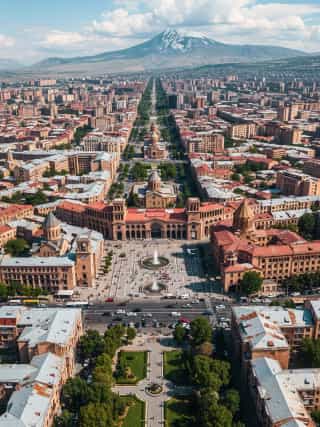
Yerevan - The Capital of Armenia
- Population
- 1,086,677
- Language
- Armenian
- Continent
- Asia
- Since
- -782
- Eco Ranking
- 94/195
Source: Environmental Performance Index 2024.
About Yerevan
Yerevan is one of the world's oldest continuously inhabited cities. It was founded in 782 BCE as the Urartian fortress of Erebuni, a fortified settlement whose name is the linguistic root of "Yerevan." The city has existed under Urartian, Persian, Hellenistic, Roman, Byzantine, Arab, Mongol, Persian, Ottoman, and Russian rule before emerging as the capital of modern Armenia. Yerevan became the capital of the short-lived First Republic of Armenia in 1918, and then the capital of the Soviet Armenian Republic. It emerged as the capital of independent Armenia following the dissolution of the USSR in 1991. Armenian national identity is deeply shaped by the Armenian Genocide of 1915-1916, in which the Ottoman Empire systematically killed an estimated 600,000 to 1.5 million Armenians. Turkey disputes the characterisation of these events as genocide, and recognition of the genocide has been a persistent point of international diplomatic tension. In 2020, Armenia suffered a decisive military defeat in the Second Nagorno-Karabakh War against Azerbaijan. In September 2023, Azerbaijan took full military control of Karabakh, and the region's Armenian population, approximately 100,000 people, fled en masse to Armenia. Yerevan absorbed more than 100,000 Karabakh refugees in a matter of days in 2023.
About Armenia
Armenia is a parliamentary republic in the South Caucasus. Following the 2018 Velvet Revolution, which ousted the long-ruling Republican Party, Prime Minister Nikol Pashinyan has governed on a reform mandate. The National Assembly sits in Yerevan. Armenia's geopolitical situation is acutely difficult: it is landlocked, its borders with Turkey and Azerbaijan are closed, and it lost significant territory and population following the 2020 and 2023 Karabakh conflicts. Armenia is a member of the Collective Security Treaty Organisation and has had a Russian military base on its territory, though relations with Russia have strained significantly since 2020.
View Yerevan on the map
Flight time from Yerevan to other capitals
| City | Distance (km) | Flight Time |
|---|---|---|
| Abu Dhabi | 2000 | 2h 21m |
| Rome | 2700 | 3h 11m |
| Paris | 3400 | 4h 0m |
| London | 3600 | 4h 14m |
| Singapore | 7400 | 8h 42m |
| Tokyo | 7900 | 9h 18m |
| Cape Town | 8700 | 10h 14m |
| Washington, D.C. | 9400 | 11h 4m |
| Buenos Aires | 13400 | 15h 46m |
| Canberra | 13600 | 16h 0m |
Capitals with similar population to Yerevan
Capitals with similar eco ranking to Yerevan
| City | Eco Rank |
|---|---|
| Bangkok | 91 |
| Sucre | 93 |
| Tunis | 93 |
| Yerevan | 94 |
| Port Vila | 95 |
| Kuwait City | 96 |
| South Tarawa | 97 |
Source: Environmental Performance Index 2024.
Frequently Asked Questions
How old is Yerevan?
Yerevan is one of the world's oldest continuously inhabited cities. It was founded in 782 BCE as the Urartian fortress of Erebuni, built by King Argishti I. This makes Yerevan older than Rome, which was traditionally founded in 753 BCE. The name Yerevan derives directly from the ancient name Erebuni.
What is the Armenian Genocide?
The Armenian Genocide refers to the systematic deportation and mass killing of Armenians by the Ottoman Empire between 1915 and 1916. Estimates of the death toll range from 600,000 to 1.5 million people. The genocide is recognised by over 30 countries and most genocide scholars, though Turkey disputes the classification. It is central to Armenian national identity and shapes Armenia's foreign policy and diaspora relations.
What happened in Nagorno-Karabakh?
Nagorno-Karabakh (Artsakh) was a disputed region between Armenia and Azerbaijan. In 2020, Azerbaijan retook much of the territory in a 44-day war. In September 2023, Azerbaijan launched a military offensive and took full control, causing the ethnic Armenian population of approximately 100,000 to flee to Armenia within days. The region's Armenian presence, which had lasted centuries, effectively ended.
When did Armenia become an independent country?
Armenia declared independence from the Soviet Union on 21 September 1991, confirmed by referendum. It had briefly been independent as the First Republic of Armenia from 1918 to 1920, before being incorporated into the Soviet Union. Yerevan has been the capital throughout both periods of independence.
Is Yerevan the largest city in Armenia?
Yes. Yerevan is by far Armenia's largest city, with over 1 million inhabitants in the city and around 1.3 million in the metropolitan area. This represents roughly a third to half of Armenia's entire population, making it one of the most demographically dominant capitals in the world relative to national population.
Sights and landmarks
Climate and best time to visit
Regional significance