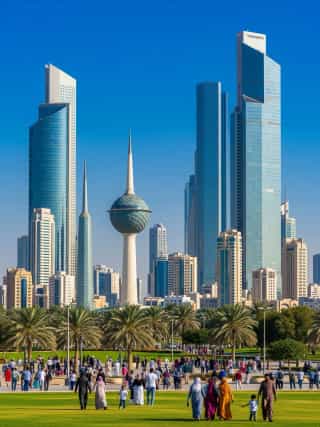
Kuwait City - The Capital of Kuwait
- Population
- 4,270,571
- Language
- Arabic
- Continent
- Asia
- Since
- 1961
- Eco Ranking
- 96/195
Source: Environmental Performance Index 2024.
About Kuwait City
Kuwait City has served as the capital of Kuwait since the country's full independence from Britain in 1961, though the settlement dates to the early 18th century when the Al-Sabah family established dominance over the area. The city and the country are effectively inseparable: Kuwait City contains the overwhelming majority of the country's population, government institutions, and economic infrastructure. The most defining event in Kuwait City's modern history was Iraq's invasion on 2 August 1990, when Saddam Hussein's forces occupied the country and the Kuwaiti government fled into exile. A US-led coalition launched Operation Desert Storm in January 1991, and Kuwait was liberated by 28 February 1991. The occupation caused extensive damage to government buildings and infrastructure, and Iraqi forces set fire to hundreds of oil wells upon withdrawal. Kuwait is governed as a constitutional emirate; the Emir holds executive authority, with a National Assembly that has historically wielded significant legislative independence compared to other Gulf states. Kuwait City is home to one of the highest concentrations of oil wealth per capita of any capital in the world.
About Kuwait
Kuwait is a constitutional emirate on the northwestern coast of the Persian Gulf, bordered by Iraq and Saudi Arabia. The Al-Sabah family has governed since the 18th century. Kuwait's elected National Assembly has a history of asserting legislative independence, dissolving and reforming multiple times due to political disputes. The country holds approximately 6 percent of the world's proven oil reserves. Kuwait's security remains heavily dependent on its defense agreement with the United States, renewed and reinforced after the 1990-1991 Gulf War.
View Kuwait City on the map
Flight time from Kuwait City to other capitals
| City | Distance (km) | Flight Time |
|---|---|---|
| Abu Dhabi | 800 | 0h 56m |
| Rome | 3500 | 4h 7m |
| Paris | 4400 | 5h 11m |
| London | 4600 | 5h 25m |
| Singapore | 6700 | 7h 53m |
| Cape Town | 7700 | 9h 4m |
| Tokyo | 8300 | 9h 46m |
| Washington, D.C. | 10500 | 12h 21m |
| Canberra | 12800 | 15h 4m |
| Buenos Aires | 13200 | 15h 32m |
Capitals with similar population to Kuwait City
Capitals with similar eco ranking to Kuwait City
| City | Eco Rank |
|---|---|
| Sucre | 93 |
| Yerevan | 94 |
| Port Vila | 95 |
| Kuwait City | 96 |
| South Tarawa | 97 |
| Mexico City | 98 |
| Montevideo | 99 |
Source: Environmental Performance Index 2024.
Frequently Asked Questions
When did Kuwait City become the capital of Kuwait?
Kuwait City became the capital of fully independent Kuwait on 19 June 1961, when Britain terminated its protectorate over the country. The Al-Sabah family had governed the area since around 1752, and Kuwait had been a British protectorate since 1899.
What happened to Kuwait City during the 1990 Iraqi invasion?
Iraqi forces invaded Kuwait City on 2 August 1990, occupying the country for seven months. The Kuwaiti government fled into exile in Saudi Arabia. A US-led multinational coalition launched a military campaign in January 1991, and Kuwait was liberated on 28 February 1991, though Iraqi forces set fire to approximately 700 oil wells before withdrawing.
Is Kuwait City the largest city in Kuwait?
Yes. Kuwait City is by far the largest city in Kuwait and functions as the country's sole major urban center. The greater Kuwait City metropolitan area encompasses the vast majority of Kuwait's total population of roughly 4.3 million people.
How is Kuwait City governed?
Kuwait City is governed as part of Kuwait's Al Asimah governorate (the Capital Governorate). Kuwait itself is a constitutional emirate in which the Emir holds executive authority, but an elected National Assembly has legislative powers and has historically challenged government decisions, including forcing ministerial resignations.
Why is Kuwait City almost synonymous with Kuwait the country?
Kuwait is one of the smallest countries in the world by area, and Kuwait City and its surrounding metropolitan area account for nearly the entire national population and economic activity. The country has no other significant urban centers of comparable size, making the capital essentially coterminous with the nation.
Sights and landmarks
Climate and best time to visit
Regional significance