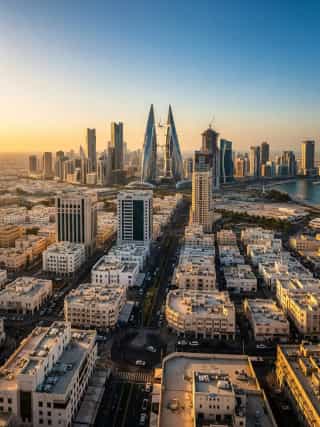
Manama - The Capital of Bahrain
- Population
- 330,000
- Language
- Arabic
- Continent
- Asia
- Since
- 1345
- Eco Ranking
- 157/195
Source: Environmental Performance Index 2024.
About Manama
Manama has served as a seat of governance over Bahrain since the Khalifa family took control of the islands in 1783, and became the formal capital of the modern state of Bahrain upon its independence from Britain on 15 August 1971. The city had long been a trading port in the Persian Gulf, important in the pearl trade before petroleum supplanted it in the 20th century. Bahrain was a British protectorate from 1820 until 1971, and Manama served as the regional administrative hub for British interests in the lower Gulf. Bahrain holds a politically significant distinction in the Arab Gulf: it is the only Arab Gulf state where a Shia Muslim majority population is governed by a Sunni royal family, the Al Khalifa dynasty. This sectarian dimension has driven periodic unrest. During the Arab Spring in February-March 2011, large protests centered on Pearl Roundabout in Manama demanded political reform. The government suppressed the protests with the assistance of Saudi Arabian and UAE troops deployed under the Gulf Cooperation Council's Peninsula Shield Force, a rare military intervention by Arab states in a fellow member state. Manama is the seat of the king, the prime minister, the parliament, and the main government ministries. Bahrain was the first Arab Gulf state to discover oil, in 1932, and consequently the first to face post-oil economic realities.
About Bahrain
Bahrain is a small island kingdom in the Persian Gulf, connected to Saudi Arabia by the King Fahd Causeway. It is a constitutional monarchy ruled by King Hamad bin Isa Al Khalifa. Bahrain hosts the US Fifth Fleet, making it a critical US military hub in the Middle East. The country has a Shia majority but is governed by the Sunni Al Khalifa dynasty. Political opposition, particularly Shia political movements, has been systematically suppressed, especially since the 2011 protests. Bahrain has sought to diversify its economy through financial services and tourism as oil revenues decline.
View Manama on the map
Flight time from Manama to other capitals
| City | Distance (km) | Flight Time |
|---|---|---|
| Abu Dhabi | 400 | 0h 28m |
| Rome | 3900 | 4h 35m |
| Paris | 4800 | 5h 39m |
| London | 5100 | 6h 0m |
| Singapore | 6300 | 7h 25m |
| Cape Town | 7500 | 8h 49m |
| Tokyo | 8300 | 9h 46m |
| Washington, D.C. | 11000 | 12h 56m |
| Canberra | 12400 | 14h 35m |
| Buenos Aires | 13300 | 15h 39m |
Capitals with similar population to Manama
| City | Population |
|---|---|
| Yamoussoukro | 355,573 |
| San José | 342,188 |
| Maseru | 330,790 |
| Nicosia | 330,000 |
| Manama | 330,000 |
| Ciudad de la Paz | 297,000 |
| Ljubljana | 295,504 |
Capitals with similar eco ranking to Manama
Source: Environmental Performance Index 2024.
Frequently Asked Questions
When did Manama become the capital of Bahrain?
Manama became the capital of fully independent Bahrain on 15 August 1971, when Britain terminated its protectorate. The Al Khalifa family had governed Bahrain from Manama since taking control of the islands in 1783, and the city had served as the seat of the British Political Residency for the Persian Gulf throughout the protectorate period.
What happened in Manama during the 2011 Arab Spring?
Beginning in February 2011, large protests broke out in Manama centered on Pearl Roundabout, with demonstrators calling for political reform, a constitutional monarchy with a genuinely elected government, and an end to sectarian discrimination. The government declared martial law and, in mid-March 2011, Saudi Arabian and UAE troops entered Bahrain under the GCC's Peninsula Shield Force to assist in suppressing the protests. Pearl Roundabout and its monument were subsequently demolished.
Why is Bahrain's sectarian composition politically significant?
Bahrain has a Shia Muslim majority, estimates range from 60 to 70 percent of the citizen population, governed by the Sunni Al Khalifa royal family. This creates a persistent political tension in which the largest religious community has historically been underrepresented in government, the military, and key institutions. Shia political movements have long called for greater political representation, and their demands have been met with restrictions rather than reforms.
What was Bahrain's historical importance before oil?
Before oil was discovered in 1932, Bahrain was one of the Persian Gulf's most important centers for the pearl diving industry. Bahraini pearls were among the most prized in global markets for centuries. The collapse of the natural pearl market in the 1930s, caused by the introduction of Japanese cultured pearls, coincided with the beginning of the oil era, which transformed the economy.
Is Manama the largest city in Bahrain?
Yes, Manama is the largest city in Bahrain. Given Bahrain's small total land area of approximately 780 square kilometers, the greater Manama area encompasses most of the country's urban population. The broader Capital Governorate, which includes Manama, houses a large portion of Bahrain's approximately 1.5 million inhabitants, the majority of whom are expatriate workers.
Sights and landmarks
Climate and best time to visit
Economy