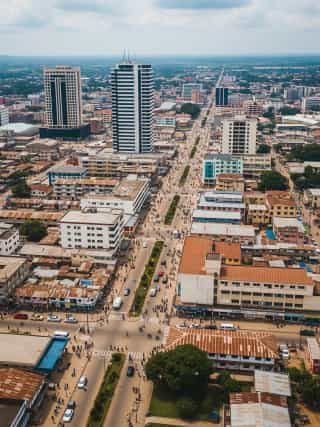
Monrovia - The Capital of Liberia
- Population
- 1,678,500
- Language
- English
- Continent
- Africa
- Since
- 1822
- Eco Ranking
- 160/195
Source: Environmental Performance Index 2024.
About Monrovia
Monrovia was established in 1822 as the primary settlement of the American Colonization Society, which resettled free Black Americans and freed slaves on the West African coast. It was named after US President James Monroe, a supporter of the colonization project. When Liberia declared independence in 1847, becoming one of Africa's first republics, Monrovia became its capital. The settlement's origins created a lasting political dynamic: the Americo-Liberian elite, descendants of the original settlers, dominated the country's politics for over a century. The True Whig Party ruled Liberia uninterruptedly from 1878 to 1980, one of the longest single-party dominances in modern political history. That system ended with a military coup in 1980. Liberia then experienced two devastating civil wars: the first from 1989 to 1996 and the second from 1999 to 2003, both of which brought severe destruction to Monrovia. Ellen Johnson Sirleaf, elected in 2005, became Africa's first female head of state. Monrovia is the only national capital in the world named after a sitting US president at the time of its founding.
About Liberia
Liberia is a presidential republic modeled closely on the United States system, with a president, senate, and house of representatives. The country's founding by freed American slaves in 1822 established a constitutional framework influenced by American political institutions, though real power was concentrated in the Americo-Liberian minority for most of its history. Two civil wars between 1989 and 2003 killed an estimated 250,000 people and devastated state institutions. Post-war reconstruction has been supported by the UN Mission in Liberia (UNMIL). Former football star George Weah was elected president in 2017 and served one term before losing the 2023 election.
View Monrovia on the map
Flight time from Monrovia to other capitals
| City | Distance (km) | Flight Time |
|---|---|---|
| Rome | 4600 | 5h 25m |
| Paris | 4900 | 5h 46m |
| London | 5100 | 6h 0m |
| Cape Town | 5400 | 6h 21m |
| Buenos Aires | 6800 | 8h 0m |
| Abu Dhabi | 7200 | 8h 28m |
| Washington, D.C. | 7500 | 8h 49m |
| Singapore | 12700 | 14h 56m |
| Tokyo | 14400 | 16h 56m |
| Canberra | 16200 | 19h 4m |
Capitals with similar population to Monrovia
Capitals with similar eco ranking to Monrovia
Source: Environmental Performance Index 2024.
Frequently Asked Questions
Why is Monrovia named after a US president?
Monrovia was named after James Monroe, the fifth President of the United States, in recognition of his support for the American Colonization Society, which established the settlement in 1822. Monroe backed the project of resettling free Black Americans in West Africa. It is the only national capital named after a US president.
When did Monrovia become the capital of Liberia?
Monrovia became the capital of the independent Republic of Liberia on July 26, 1847, when Liberia declared independence from the American Colonization Society. It had served as the main settlement and administrative center since 1822.
What were Liberia's civil wars and how did they affect Monrovia?
Liberia experienced two civil wars: the First Liberian Civil War (1989-1996) and the Second Liberian Civil War (1999-2003). Both conflicts brought heavy fighting to Monrovia, resulting in mass civilian casualties, displacement, and the near-total destruction of the city's infrastructure. The wars killed an estimated 250,000 people in total.
Who was the Americo-Liberian elite and why did they dominate politics?
The Americo-Liberians were descendants of the freed American slaves and free Black Americans who founded Liberia in 1822. They established a ruling class that controlled political and economic power for over a century, with the True Whig Party governing continuously from 1878 to 1980. Indigenous Liberians, who made up the vast majority of the population, were largely excluded from political power during this period.
Is Monrovia the largest city in Liberia?
Yes. Monrovia is by far the largest city in Liberia. Its metropolitan area is home to well over a million people, a large proportion of Liberia's total population of around 5 million. The city is the country's political, economic, and commercial center.
Sights and landmarks
Climate and best time to visit
Culture and customs
Economy