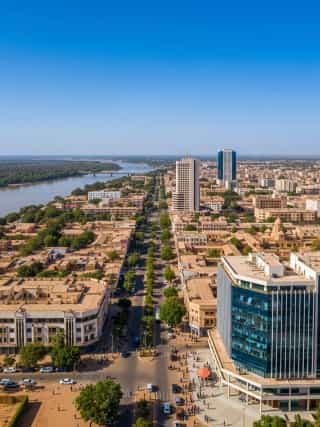
Niamey - The Capital of Niger
- Population
- 1,292,023
- Language
- French
- Continent
- Africa
- Since
- 1960
- Eco Ranking
- 126/195
Source: Environmental Performance Index 2024.
About Niamey
Niamey became the capital of the French colonial territory of Niger in 1926 and retained that status when Niger gained independence in 1960. The city sits on the Niger River in the southwest of the country, near the borders with Burkina Faso and Benin. Niger has experienced five coups since independence, in 1974, 1996, 1999, 2010, and most recently in July 2023, when the Presidential Guard overthrew elected President Mohamed Bazoum and placed him under house arrest in Niamey. The 2023 coup was significant beyond Niger's borders: the junta expelled French troops stationed in the country, severed cooperation with France, and looked toward Russia's Wagner Group for security partnerships, dramatically shifting Niger's geopolitical alignment. ECOWAS (the Economic Community of West African States) threatened military intervention to restore constitutional order but did not follow through. Bazoum remains detained in Niamey. Niger is consistently ranked among the world's least developed countries on the UN Human Development Index. Niger is a major transit route for trans-Saharan migration toward Europe and has been a key partner in EU migration containment efforts.
About Niger
Niger is currently governed by a military junta, the National Council for the Safeguard of the Homeland (CNSP), following the July 2023 coup. General Abdourahamane Tchiani, head of the Presidential Guard, leads the junta. Niger, Mali, and Burkina Faso, all under military rule after coups, formed the Alliance of Sahel States in 2023, withdrew from ECOWAS, and have collectively expelled French and other Western forces. Niger contains significant uranium deposits that have historically been mined by French company Areva, adding a resource dimension to the political crisis. The country borders seven countries and is entirely landlocked.
View Niamey on the map
Flight time from Niamey to other capitals
| City | Distance (km) | Flight Time |
|---|---|---|
| Rome | 3300 | 3h 53m |
| Paris | 3900 | 4h 35m |
| London | 4200 | 4h 56m |
| Cape Town | 5500 | 6h 28m |
| Abu Dhabi | 5600 | 6h 35m |
| Washington, D.C. | 8100 | 9h 32m |
| Buenos Aires | 8300 | 9h 46m |
| Singapore | 11200 | 13h 11m |
| Tokyo | 13000 | 15h 18m |
| Canberra | 15900 | 18h 42m |
Capitals with similar population to Niamey
| City | Population |
|---|---|
| Dublin | 1,388,233 |
| Montevideo | 1,381,611 |
| Tegucigalpa | 1,363,000 |
| Prague | 1,335,084 |
| Niamey | 1,292,023 |
| Brussels | 1,218,255 |
| Nouakchott | 1,195,600 |
Capitals with similar eco ranking to Niamey
| City | Eco Rank |
|---|---|
| Nuku'alofa | 123 |
| Luanda | 124 |
| Tegucigalpa | 124 |
| Niamey | 126 |
| Beirut | 128 |
| Freetown | 128 |
| Asunción | 130 |
Source: Environmental Performance Index 2024.
Frequently Asked Questions
When did Niamey become the capital of Niger?
Niamey became the capital of the French colonial territory of Niger in 1926, when the French colonial administration reorganized the region. It became the capital of the independent Republic of Niger on August 3, 1960, when Niger gained independence from France.
What happened in Niger's 2023 coup?
On July 26, 2023, members of the Presidential Guard in Niamey overthrew President Mohamed Bazoum, who had been democratically elected in 2021. General Abdourahamane Tchiani assumed leadership of the junta. The coup was condemned by the UN, the African Union, ECOWAS, France, and the United States. Bazoum remained under house arrest in Niamey.
Why did Niger expel French troops after the 2023 coup?
The military junta that seized power in July 2023 demanded the withdrawal of approximately 1,500 French troops stationed in Niger as part of counter-terrorism operations in the Sahel. The junta framed France as a symbol of colonial domination and aligned Niger with Russia's Wagner Group and neighboring military governments in Mali and Burkina Faso.
Is Niger one of the world's poorest countries?
Yes. Niger consistently ranks last or near last on the UN Human Development Index. The country has one of the world's highest birth rates, limited arable land, and an economy heavily dependent on subsistence agriculture and uranium exports. Recurring droughts and armed conflict in the Lake Chad Basin and Sahel region compound its development challenges.
Is Niamey the largest city in Niger?
Yes. Niamey is by far the largest city in Niger, with a population of approximately 1.3 million, a large share of the country's mostly rural population of around 25 million. It is the country's only major urban center, serving as Niger's political, commercial, and administrative hub.
Sights and landmarks
Climate and best time to visit
Culture and customs
Economy