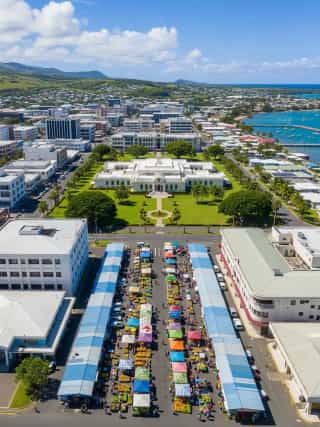
Nuku'alofa - The Capital of Tonga
- Population
- 23,658
- Language
- Tongan
- Continent
- Oceania
- Since
- 1875
- Eco Ranking
- 123/195
Source: Environmental Performance Index 2024.
About Nuku'alofa
Nuku'alofa serves as the seat of government for the world's last remaining Polynesian monarchy. The city became the capital of Tonga when the kingdom was formally unified and a constitution was adopted in 1875 under King George Tupou I. Unlike most Pacific nations, Tonga was never formally colonized, it signed a Treaty of Friendship with Britain in 1900, becoming a British protectorate, but retained its internal sovereignty throughout. Britain recognized Tongan independence fully in 1970. For most of the 20th century, the kingdom was governed as an absolute monarchy before a decade-long push for democratic reform culminated in the Constitutional Reform Act of 2010, which transferred significant executive power from the king to a parliamentary government. The prime minister now heads government, while the monarch retains a ceremonial role. The legislature, known as the Legislative Assembly, meets in Nuku'alofa. Tonga is the only Pacific Island monarchy to have undergone a peaceful transition from absolute to constitutional rule without colonial intervention.
About Tonga
Tonga is a constitutional monarchy in the South Pacific comprising 169 islands, of which 36 are inhabited. Legislative power is exercised by a unicameral parliament with seats divided between elected people's representatives and nobles appointed by the king. Tonga is the only state in the Pacific that has maintained an unbroken line of indigenous sovereignty, it was never annexed by a colonial power.
View Nuku'alofa on the map
Flight time from Nuku'alofa to other capitals
| City | Distance (km) | Flight Time |
|---|---|---|
| Canberra | 3800 | 4h 28m |
| Tokyo | 7900 | 9h 18m |
| Singapore | 9100 | 10h 42m |
| Buenos Aires | 10900 | 12h 49m |
| Washington, D.C. | 12100 | 14h 14m |
| Cape Town | 13700 | 16h 7m |
| Abu Dhabi | 14900 | 17h 32m |
| London | 16600 | 19h 32m |
| Paris | 16900 | 19h 53m |
| Rome | 17600 | 20h 42m |
Capitals with similar population to Nuku'alofa
| City | Population |
|---|---|
| Majuro | 28,000 |
| Victoria | 26,450 |
| Nuku'alofa | 23,658 |
| Andorra la Vella | 22,886 |
| St. John's | 22,219 |
| Castries | 22,000 |
| Belmopan | 16,451 |
Capitals with similar eco ranking to Nuku'alofa
Source: Environmental Performance Index 2024.
Frequently Asked Questions
Why is Nuku'alofa the capital of Tonga?
Nuku'alofa became the capital when King George Tupou I unified the Tongan islands under a single constitutional government in 1875. The city on the island of Tongatapu had long been the residence of the royal family and was the natural center of political authority. It has remained the seat of government ever since.
Was Tonga ever colonized?
Tonga was never formally colonized. It became a British protectorate in 1900 through a Treaty of Friendship but retained its own government, monarchy, and legal system. Britain recognized Tonga's full independence in 1970, making it one of the few Pacific nations that never lost sovereignty to a colonial power.
When did Tonga become a constitutional monarchy?
Tonga transitioned from an absolute to a constitutional monarchy in 2010 following a decade of political reform. The Constitutional Reform Act transferred executive power to an elected parliament and prime minister, significantly reducing the king's direct role in governance.
Is Nuku'alofa the largest city in Tonga?
Yes, Nuku'alofa is both the capital and the largest city in Tonga, located on the northern coast of the main island of Tongatapu. With a population of roughly 23,000, it is one of the smaller capital cities in the Pacific region.
How is Tonga governed today?
Tonga is governed as a constitutional monarchy with a parliamentary system. The Legislative Assembly includes seats for elected commoners and hereditary nobles. The prime minister holds executive authority, while the king performs a largely ceremonial role as head of state.
Sights and landmarks
Climate and best time to visit
Culture and customs
Economy