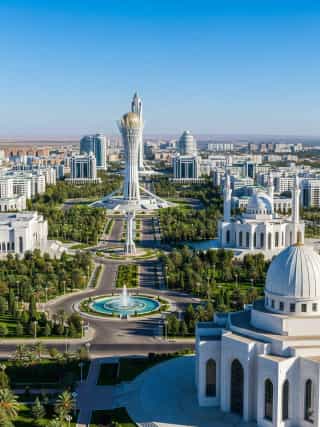
Ashgabat - The Capital of Turkmenistan
- Population
- 1,032,000
- Language
- Turkmen
- Continent
- Asia
- Since
- 1991
- Eco Ranking
- 120/195
Source: Environmental Performance Index 2024.
About Ashgabat
Ashgabat is the capital of Turkmenistan, one of the world's most isolated and authoritarian states. A Russian frontier fort was established on the site in 1881, and the city grew as an administrative center of Russian Turkestan. On 6 October 1948, a catastrophic earthquake of magnitude 7.3 almost entirely destroyed the city, killing an estimated 110,000 to 176,000 people, a death toll the Soviet authorities suppressed for decades. Ashgabat was rebuilt as a Soviet city and served as the capital of the Turkmen Soviet Socialist Republic. When Turkmenistan declared independence in 1991, Saparmurat Niyazov, who styled himself Turkmenbashi ('Father of all Turkmen'), transformed Ashgabat into a monument to his personality cult, constructing vast white marble government buildings, golden statues, and a rotating gold-plated statue of himself that tracked the sun. Niyazov died in 2006; his successor Gurbanguly Berdimuhamedov continued the tradition of monumental architecture and authoritarian rule. Ashgabat entered the Guinness World Records for having the highest density of white marble-clad buildings in the world. The current president, Serdar Berdimuhamedov (son of the previous leader), assumed power in 2022.
About Turkmenistan
Turkmenistan is a presidential republic in constitutional form but functions as one of the world's most repressive authoritarian states. It has been governed by only three presidents since independence, with power effectively transferred from Niyazov to Berdimuhamedov and then from father to son. The country holds the world's fourth-largest natural gas reserves but its population sees little economic benefit. Turkmenistan maintains a policy of permanent neutrality recognized by the United Nations since 1995.
View Ashgabat on the map
Flight time from Ashgabat to other capitals
| City | Distance (km) | Flight Time |
|---|---|---|
| Abu Dhabi | 1500 | 1h 46m |
| Rome | 3900 | 4h 35m |
| Paris | 4600 | 5h 25m |
| London | 4700 | 5h 32m |
| Singapore | 6200 | 7h 18m |
| Tokyo | 7000 | 8h 14m |
| Cape Town | 9000 | 10h 35m |
| Washington, D.C. | 10300 | 12h 7m |
| Canberra | 12400 | 14h 35m |
| Buenos Aires | 14400 | 16h 56m |
Capitals with similar population to Ashgabat
Capitals with similar eco ranking to Ashgabat
| City | Eco Rank |
|---|---|
| Brazzaville | 116 |
| San Salvador | 117 |
| Kuala Lumpur | 118 |
| Palikir | 119 |
| Ashgabat | 120 |
| Baku | 121 |
| Nuku'alofa | 123 |
Source: Environmental Performance Index 2024.
Frequently Asked Questions
When did Ashgabat become the capital of Turkmenistan?
Ashgabat became the capital of independent Turkmenistan on 27 October 1991, when the country declared independence from the Soviet Union. It had previously served as the capital of the Turkmen Soviet Socialist Republic since 1924.
What happened to Ashgabat in 1948?
On 6 October 1948, a 7.3-magnitude earthquake struck Ashgabat and nearly leveled the city. Estimates of the death toll range from 110,000 to over 170,000 people, making it one of the deadliest earthquakes of the 20th century. Soviet authorities suppressed information about the disaster for decades; the earthquake was not publicly acknowledged in Turkmenistan until after independence.
Why is Ashgabat known for white marble buildings?
Beginning in the 1990s under President Niyazov and continuing under Berdimuhamedov, Ashgabat underwent a massive state-directed construction program using white marble cladding for government buildings, monuments, and public spaces. The project was intended to project national prestige. Ashgabat holds a Guinness World Record for the highest density of white marble-clad buildings globally.
Is Ashgabat open to foreign visitors?
Turkmenistan is one of the most difficult countries in the world to visit. Foreign nationals require a government-issued visa and, in most cases, must travel with a state-approved guide. Journalists and independent researchers face severe restrictions. The country was ranked among the least free in global press freedom and political rights indices.
Who governs Turkmenistan from Ashgabat?
Turkmenistan is governed by President Serdar Berdimuhamedov, who assumed power in March 2022 following elections that international observers did not consider free or fair. His father, Gurbanguly Berdimuhamedov, remains influential as Chairman of the upper house of Parliament, creating what analysts describe as a dual-power arrangement within a family dictatorship.
Sights and landmarks
Climate and best time to visit
Regional significance
Economy