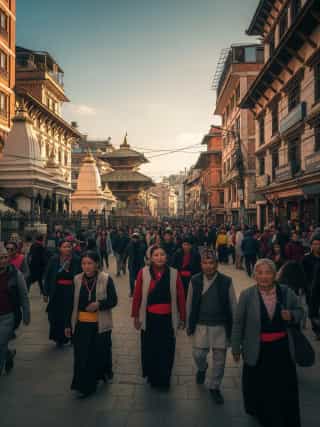
Kathmandu - The Capital of Nepal
- Population
- 1,003,285
- Language
- Nepali
- Continent
- Asia
- Since
- 1768
- Eco Ranking
- 164/195
Source: Environmental Performance Index 2024.
About Kathmandu
Kathmandu became the capital of a unified Nepal in 1768, when Prithvi Narayan Shah of the Gorkha Kingdom conquered the Kathmandu Valley, then divided among three small Newar city-states, Kathmandu, Patan, and Bhaktapur, and established it as the seat of his expanded kingdom. The city had been an important center of trade and Buddhist and Hindu religious culture long before unification. Nepal remained a sovereign monarchy and was never formally colonized, though it existed under significant British influence during the 19th and early 20th centuries. The country was governed under an absolute monarchy for most of its history, with political parties banned for decades under the Panchayat system. A decade-long Maoist insurgency from 1996 to 2006 resulted in over 17,000 deaths and a political crisis that brought down the monarchy. Following a peace agreement in 2006, Nepal abolished the monarchy in 2008 and declared itself a federal democratic republic, ending 240 years of Shah dynasty rule. Kathmandu houses the Federal Parliament, the Office of the President, and the Supreme Court. Nepal is one of only a handful of countries to have abolished a monarchy and become a republic in the 21st century. The city was severely affected by the 2015 earthquake, which killed nearly 9,000 people and caused widespread structural damage to historic areas.
About Nepal
Nepal is a federal democratic republic in South Asia, bordered by China to the north and India on all other sides. It abolished its monarchy in 2008 following a peace agreement ending a decade-long Maoist insurgency. Nepal is constitutionally a secular state, having previously been the world's only official Hindu kingdom. It is governed under a bicameral Federal Parliament. Nepal has experienced significant political instability since becoming a republic, with frequent changes of government. The country is landlocked and heavily dependent economically on India and on remittances from Nepali workers abroad.
View Kathmandu on the map
Flight time from Kathmandu to other capitals
| City | Distance (km) | Flight Time |
|---|---|---|
| Abu Dhabi | 3100 | 3h 39m |
| Singapore | 3500 | 4h 7m |
| Tokyo | 5200 | 6h 7m |
| Rome | 6600 | 7h 46m |
| Paris | 7200 | 8h 28m |
| London | 7300 | 8h 35m |
| Canberra | 9700 | 11h 25m |
| Cape Town | 9800 | 11h 32m |
| Washington, D.C. | 12400 | 14h 35m |
| Buenos Aires | 16500 | 19h 25m |
Capitals with similar population to Kathmandu
Capitals with similar eco ranking to Kathmandu
Source: Environmental Performance Index 2024.
Frequently Asked Questions
When did Kathmandu become the capital of Nepal?
Kathmandu became the capital of a unified Nepal in 1768, when Prithvi Narayan Shah of the Gorkha Kingdom conquered the Kathmandu Valley and established it as the seat of his kingdom. Before this, the valley was divided among three independent Newar kingdoms.
Why did Nepal abolish its monarchy?
Nepal abolished its monarchy in May 2008 following a peace process that ended a decade-long Maoist insurgency. The political agreement between the Maoists and parliamentary parties included the abolition of the 240-year-old Shah dynasty. King Gyanendra, who had attempted to exercise absolute power in 2005, was removed and Nepal became a federal democratic republic.
Was Nepal ever colonized?
Nepal was never formally colonized, though it existed under significant British influence. After a war with British India in 1814-1816, Nepal ceded territory and effectively accepted British oversight of its foreign relations. It maintained internal sovereignty and was never part of the British Empire, unlike nearly all of its neighbors.
What was the impact of the 2015 earthquake on Kathmandu?
The April 2015 earthquake, measuring magnitude 7.8, killed approximately 9,000 people across Nepal, with Kathmandu severely affected. Numerous historic temples and structures in the UNESCO-listed Durbar Squares were destroyed or damaged. The earthquake caused an estimated $7 billion in damages and triggered a major international relief operation.
Is Kathmandu the largest city in Nepal?
Yes, Kathmandu is Nepal's largest city and the center of its largest metropolitan area. The Kathmandu Valley, which includes the cities of Patan (Lalitpur) and Bhaktapur in addition to Kathmandu itself, is home to approximately 3 million people and is the political, economic, and cultural center of the country.
Sights and landmarks
Climate and best time to visit
Regional significance
Culture and customs