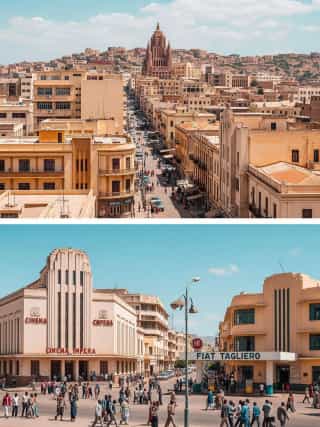
Asmara - The Capital of Eritrea
- Population
- 963,000
- Language
- Arabic
- Continent
- Africa
- Since
- 1900
- Eco Ranking
- 174/195
Source: Environmental Performance Index 2024.
About Asmara
Asmara became the capital of Italian Eritrea in 1900, when Italy established it as the administrative center of its East African colony. Italian colonial authorities rebuilt the city extensively in the 1930s, constructing a dense ensemble of rationalist, futurist, and Art Deco architecture that survives largely intact and earned the city UNESCO World Heritage status in 2017. After Italy's defeat in World War II, Eritrea came under British administration and then, in 1952, was federated with Ethiopia under a UN-brokered arrangement. Ethiopia unilaterally annexed Eritrea in 1962, and Asmara became a provincial capital of the Ethiopian empire under Haile Selassie and later the Derg. A thirty-year armed independence struggle followed, ending in Eritrean independence in 1991 (formally ratified by referendum in 1993), at which point Asmara became the capital of Africa's newest state. Under President Isaias Afwerki, who has governed without elections since independence, Asmara is the seat of a government that the UN and international human rights bodies have repeatedly cited for crimes against humanity. Despite its architectural heritage, the city is largely closed to independent foreign scrutiny.
About Eritrea
Eritrea is a single-party presidential state governed without elections since independence in 1993. The ruling People's Front for Democracy and Justice (PFDJ) holds a monopoly on political power. Eritrea has no independent press, no functioning legislature, and operates one of the largest military conscription programs in the world, with indefinite service periods. The UN Commission of Inquiry has found evidence of crimes against humanity committed by Eritrean state authorities.
View Asmara on the map
Flight time from Asmara to other capitals
| City | Distance (km) | Flight Time |
|---|---|---|
| Abu Dhabi | 1900 | 2h 14m |
| Rome | 3900 | 4h 35m |
| Paris | 5000 | 5h 53m |
| London | 5300 | 6h 14m |
| Cape Town | 5900 | 6h 56m |
| Singapore | 7300 | 8h 35m |
| Tokyo | 10000 | 11h 46m |
| Washington, D.C. | 11100 | 13h 4m |
| Buenos Aires | 11600 | 13h 39m |
| Canberra | 12800 | 15h 4m |
Capitals with similar population to Asmara
Capitals with similar eco ranking to Asmara
Source: Environmental Performance Index 2024.
Frequently Asked Questions
When did Asmara become the capital of Eritrea?
Asmara became the capital of independent Eritrea in 1991, when the Eritrean People's Liberation Front (EPLF) liberated the city after a thirty-year independence war against Ethiopia. Independence was formally confirmed by a 1993 referendum, and Asmara became the capital of the internationally recognized state.
Why is Asmara a UNESCO World Heritage Site?
Asmara was inscribed as a UNESCO World Heritage Site in 2017 for its exceptionally well-preserved collection of early 20th-century Italian colonial architecture, including rationalist, futurist, Art Deco, and modernist buildings. The city's architectural ensemble, built largely in the 1930s, is considered among the most intact examples of Italian colonial urban planning.
Was Asmara part of Ethiopia before independence?
Yes. Following World War II, Eritrea was federated with Ethiopia in 1952 under a UN arrangement. Ethiopia dissolved the federation in 1962 and annexed Eritrea outright, making Asmara a provincial capital within the Ethiopian state. This annexation triggered the armed independence struggle that lasted until 1991.
Who governs from Asmara?
Eritrea is governed by President Isaias Afwerki, who has held power since independence in 1993 without holding a presidential election. No national elections have ever been held in Eritrea. The ruling PFDJ party controls all state functions, and the constitution adopted in 1997 has never been implemented.
Is Asmara the largest city in Eritrea?
Yes. Asmara is the largest city in Eritrea, with a population of approximately 1 million people. It is significantly larger than any other Eritrean city and serves as the sole center of the country's government, commerce, and communications infrastructure.
Sights and landmarks
Climate and best time to visit
Culture and customs
Economy