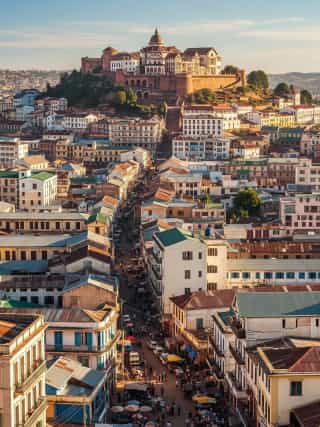
Antananarivo - The Capital of Madagascar
- Population
- 3,058,800
- Language
- Malagasy
- Continent
- Africa
- Since
- 1897
- Eco Ranking
- 173/195
Source: Environmental Performance Index 2024.
About Antananarivo
Antananarivo, commonly abbreviated as Tana, has been the political center of Madagascar since the 17th century, when it served as the royal capital of the Merina Kingdom. The city was founded around 1625 by King Andrianjaka, who captured the hilltop site from a rival clan and built his royal palace, the Rova, there. Under successive Merina monarchs, particularly Queen Ranavalona I and King Radama I, Antananarivo was the seat of a kingdom that eventually unified most of the island. France declared Madagascar a protectorate in 1885 and a colony in 1896, abolishing the Merina monarchy but retaining Antananarivo as the administrative capital. French colonial governance operated from the city until independence on 26 June 1960. The post-independence republic has been politically turbulent: Madagascar has experienced multiple coups, constitutional crises, and contested elections. The National Assembly and the Senate, along with the presidency and government ministries, are based in Antananarivo. The ruined Rova palace complex on the central hilltop remains a potent political symbol of pre-colonial sovereignty.
About Madagascar
Madagascar is a semi-presidential republic operating under a 2010 constitution adopted following a political crisis and coup in 2009. The President is elected by popular vote and holds significant executive authority, appointing the Prime Minister. Madagascar is the world's fourth-largest island and is considered one of the world's poorest countries. The country has experienced significant political instability since independence, including coups in 1972, 1975, and 2009.
View Antananarivo on the map
Flight time from Antananarivo to other capitals
| City | Distance (km) | Flight Time |
|---|---|---|
| Cape Town | 3300 | 3h 53m |
| Abu Dhabi | 4900 | 5h 46m |
| Singapore | 6500 | 7h 39m |
| Rome | 7700 | 9h 4m |
| Paris | 8800 | 10h 21m |
| London | 9100 | 10h 42m |
| Canberra | 9800 | 11h 32m |
| Buenos Aires | 10200 | 12h 0m |
| Tokyo | 11400 | 13h 25m |
| Washington, D.C. | 14300 | 16h 49m |
Capitals with similar population to Antananarivo
Capitals with similar eco ranking to Antananarivo
Source: Environmental Performance Index 2024.
Frequently Asked Questions
When did Antananarivo become the capital of Madagascar?
Antananarivo became the capital of independent Madagascar on 26 June 1960. However, the city had functioned as a capital for centuries before: it was the royal seat of the Merina Kingdom from the early 17th century and the administrative capital of French colonial Madagascar from 1897.
What was the Merina Kingdom and what role did Antananarivo play?
The Merina Kingdom was a highland Malagasy polity that came to dominate most of Madagascar by the early 19th century. Antananarivo served as its royal capital from the early 17th century, home to the Rova royal palace complex on the city's highest hill. The kingdom maintained its own court, army, and diplomatic relations until French colonization in 1896.
Is Antananarivo the largest city in Madagascar?
Yes. Antananarivo is the largest city in Madagascar by a considerable margin, with a population of over 3 million in the metropolitan area. The next largest cities are significantly smaller. The capital concentrates government, higher education, and economic activity.
Has Madagascar had a stable government since independence?
No. Madagascar's post-independence history has been marked by significant political instability. The country experienced coups in 1972, 1975, and 2009. The 2009 crisis, in which President Marc Ravalomanana was ousted by a military-backed opposition leader, led to international sanctions and a constitutional reorganization finalized in 2010.
What is the Rova of Antananarivo?
The Rova is the former royal palace complex of the Merina monarchs, located on the highest hill in Antananarivo. It served as the seat of Merina royal power from the 17th century until French colonization in 1896. A devastating fire in 1995 destroyed much of the palace, but reconstruction efforts have been underway since. It remains a central symbol of Malagasy national identity.
Sights and landmarks
Climate and best time to visit
Culture and customs
Economy