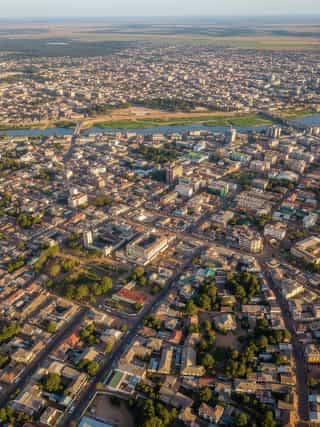
Bangui - The Capital of Central African Republic
- Population
- 889,231
- Language
- French
- Continent
- Africa
- Since
- 1889
- Eco Ranking
- 132/195
Source: Environmental Performance Index 2024.
About Bangui
Bangui was established in 1889 by French colonial forces on the northern bank of the Ubangi River, which forms the border between what is now the Central African Republic and the Democratic Republic of the Congo. The site was chosen as an administrative outpost for French Equatorial Africa, and it became the capital when the Central African Republic gained independence from France on 13 August 1960. Since independence, the country has been defined by political instability: Bangui has been the seat of government through at least six successful coups, several civil wars, and the rise of competing armed factions that have at times controlled large portions of national territory. The most recent major political crisis began in 2012-2013, when the Séléka rebel coalition seized Bangui and removed President François Bozizé, triggering a humanitarian catastrophe. Russian and Rwandan military personnel now have a significant presence in the capital under bilateral security arrangements. Bangui houses the National Assembly and the presidency, though effective governmental control over the country's territory beyond the capital has frequently been limited.
About Central African Republic
The Central African Republic is a presidential republic, though civilian governance has repeatedly been interrupted by military force since 1960. The state's authority is heavily concentrated in Bangui; much of the country's territory has been contested by armed groups for over a decade. Since 2018, Russia has become a primary security partner, deploying Wagner Group-affiliated personnel who now play a direct role in the country's military and political affairs.
View Bangui on the map
Flight time from Bangui to other capitals
| City | Distance (km) | Flight Time |
|---|---|---|
| Rome | 4200 | 4h 56m |
| Cape Town | 4300 | 5h 4m |
| Abu Dhabi | 4400 | 5h 11m |
| Paris | 5200 | 6h 7m |
| London | 5500 | 6h 28m |
| Buenos Aires | 9100 | 10h 42m |
| Singapore | 9500 | 11h 11m |
| Washington, D.C. | 10200 | 12h 0m |
| Tokyo | 12500 | 14h 42m |
| Canberra | 13900 | 16h 21m |
Capitals with similar population to Bangui
Capitals with similar eco ranking to Bangui
| City | Eco Rank |
|---|---|
| Asunción | 130 |
| Kinshasa | 130 |
| Khartoum | 131 |
| Maputo | 132 |
| Bangui | 132 |
| Sri Jayawardenepura Kotte | 133 |
| Mbabane | 134 |
Source: Environmental Performance Index 2024.
Frequently Asked Questions
Why is Bangui the capital of the Central African Republic?
Bangui was established by French colonial administrators in 1889 as the main administrative center for the territory then known as Ubangi-Shari. When the Central African Republic became independent in 1960, Bangui naturally assumed the role of national capital as it already housed the colonial administration.
How many coups has the Central African Republic experienced?
The Central African Republic has experienced at least six successful coups since independence in 1960, making it one of the most coup-prone states in post-colonial Africa. These include the self-proclaimed emperor Jean-Bédel Bokassa's takeover in 1966 and the Séléka coalition's seizure of power in 2013.
Who founded Bangui?
Bangui was founded by French colonial officer Michel Dolisie in 1889 as a military and administrative post on the Ubangi River. The name Bangui derives from the local Sango word referring to the rapids on the river near the settlement.
Is Bangui the largest city in the Central African Republic?
Yes. Bangui is the largest city in the country by a wide margin, home to roughly a quarter of the entire national population. The second-largest towns are significantly smaller, reflecting the extreme urban primacy typical of many post-colonial African states.
What is the current political situation in Bangui?
As of 2025, Bangui is governed under President Faustin-Archange Touadéra, who was re-elected in 2020 in a disputed vote. The government relies heavily on Russian military support and Wagner Group-affiliated forces for its security. Armed groups continue to operate in large parts of the country outside the capital.
Sights and landmarks
Climate and best time to visit
Culture and customs
Economy