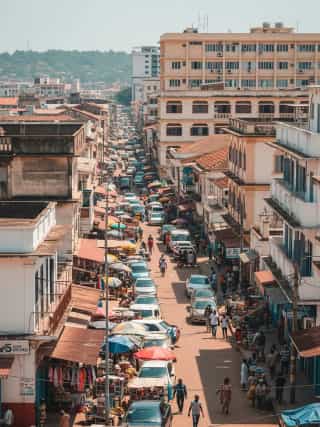
Bissau - The Capital of Guinea-Bissau
- Population
- 492,004
- Language
- Portuguese
- Continent
- Africa
- Since
- 1446
- Eco Ranking
- 112/195
Source: Environmental Performance Index 2024.
About Bissau
Bissau was founded as a Portuguese colonial fort and trading post in 1687 and became the capital of Portuguese Guinea. When Guinea-Bissau declared independence in 1974, following an eleven-year armed independence struggle led by the PAIGC (African Party for the Independence of Guinea and Cape Verde), Bissau became the capital of one of the world's newest states. The independence movement was notable for having declared a government in liberated territory as early as 1973, Portugal only formally recognized independence after the Carnation Revolution toppled the Estado Novo regime in Lisbon. Since independence, Guinea-Bissau has been one of the most politically unstable states in the world: it has experienced more than nine coups or coup attempts, no elected president has ever completed a full term in office, and the military has repeatedly intervened in civilian governance. The country also became a significant transit hub for cocaine trafficking from South America to Europe in the 2000s, leading to characterizations as Africa's first 'narco-state.' Bissau houses the National People's Assembly and the offices of the presidency and government. The city's infrastructure reflects decades of underinvestment and political disruption.
About Guinea-Bissau
Guinea-Bissau is a presidential republic and one of the world's least developed countries. Since independence in 1974, no elected president has served a full term, and the military has repeatedly removed civilian governments. The country ranks near the bottom of the UN Human Development Index. Drug trafficking, particularly of South American cocaine transiting through the country to Europe, has significantly corrupted state institutions.
View Bissau on the map
Flight time from Bissau to other capitals
| City | Distance (km) | Flight Time |
|---|---|---|
| Rome | 4300 | 5h 4m |
| Paris | 4400 | 5h 11m |
| London | 4600 | 5h 25m |
| Cape Town | 6200 | 7h 18m |
| Washington, D.C. | 6700 | 7h 53m |
| Buenos Aires | 6900 | 8h 7m |
| Abu Dhabi | 7500 | 8h 49m |
| Singapore | 13200 | 15h 32m |
| Tokyo | 14100 | 16h 35m |
| Canberra | 17000 | 20h 0m |
Capitals with similar population to Bissau
| City | Population |
|---|---|
| San Salvador | 525,990 |
| Juba | 525,953 |
| Bissau | 492,004 |
| Tallinn | 437,619 |
| Bratislava | 432,864 |
| Canberra | 431,380 |
| Windhoek | 431,000 |
Capitals with similar eco ranking to Bissau
Source: Environmental Performance Index 2024.
Frequently Asked Questions
When did Bissau become the capital of Guinea-Bissau?
Bissau became the capital of independent Guinea-Bissau in 1974, when Portugal formally recognized the country's independence following the Carnation Revolution in Lisbon. The PAIGC independence movement had already declared statehood in 1973, but Portuguese recognition came after the regime change in Lisbon.
How many coups has Guinea-Bissau experienced?
Guinea-Bissau has experienced more than nine successful or attempted coups since independence in 1974, making it one of the most coup-affected countries in the world. No elected president has ever completed a full term in office, and the military has been a constant factor in the country's political life.
Why is Guinea-Bissau sometimes called a narco-state?
From the early 2000s, Guinea-Bissau became a major transit point for cocaine shipped from South America, particularly Colombia, to European markets. Weak state institutions, a poorly paid military, and political instability allowed drug trafficking networks to penetrate government and military structures deeply, leading international observers to describe it as one of the world's first narco-states.
Who founded Bissau?
Bissau was established by Portuguese traders and colonial forces in 1687 as a fortified trading post on the Geba River estuary. It served as the administrative center of Portuguese Guinea and grew into the territory's main urban settlement, a role it retained after independence.
Is Bissau the largest city in Guinea-Bissau?
Yes. Bissau is the largest city in Guinea-Bissau, with a population of around 492,000, representing roughly a quarter of the country's total population. The city's dominance over the national urban hierarchy is typical of post-colonial states where colonial administration concentrated resources in a single center.
Sights and landmarks
Climate and best time to visit
Regional significance
Economy