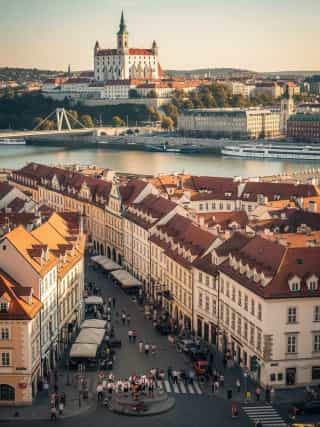
Bratislava - The Capital of Slovakia
- Population
- 432,864
- Language
- Slovak
- Continent
- Europe
- Since
- 1993
- Eco Ranking
- 18/195
Source: Environmental Performance Index 2024.
About Bratislava
Bratislava became a national capital only on 1 January 1993, the date on which Czechoslovakia peacefully divided into two separate states, the Czech Republic and Slovakia, in what is commonly called the Velvet Divorce. Before that date, the city had been the capital of the Slovak Socialist Republic within Czechoslovakia, but Prague had been the federal capital. Bratislava's political history stretches back much further: under its German name Pressburg and Hungarian name Pozsony, it served as the capital of the Kingdom of Hungary from 1536 to 1783, after the Ottoman conquest of Buda forced the Hungarian court to relocate northward. Hungarian kings were crowned in Bratislava for over two centuries. After World War I, the city was incorporated into the newly formed Czechoslovakia and renamed Bratislava. Today it houses the National Council of the Slovak Republic (parliament), the President, and the government. Bratislava is unusual among EU capitals for its geography: it borders both Austria and Hungary, making it the only EU capital that borders two other EU member states directly. Vienna is only 55 kilometers away.
About Slovakia
Slovakia is a parliamentary republic and a member of the European Union and NATO. It adopted the euro in 2009. Political life since independence has been marked by the long dominance of Robert Fico's Smer party, punctuated by significant anti-corruption protests following the 2018 murder of investigative journalist Ján Kuciak and his fiancée. Fico returned to the premiership in 2023 and was shot and seriously wounded in an assassination attempt in May 2024.
View Bratislava on the map
Flight time from Bratislava to other capitals
| City | Distance (km) | Flight Time |
|---|---|---|
| Rome | 800 | 0h 56m |
| Paris | 1100 | 1h 18m |
| London | 1300 | 1h 32m |
| Abu Dhabi | 4200 | 4h 56m |
| Washington, D.C. | 7200 | 8h 28m |
| Tokyo | 9100 | 10h 42m |
| Cape Town | 9100 | 10h 42m |
| Singapore | 9700 | 11h 25m |
| Buenos Aires | 11900 | 14h 0m |
| Canberra | 15900 | 18h 42m |
Capitals with similar population to Bratislava
Capitals with similar eco ranking to Bratislava
Source: Environmental Performance Index 2024.
Frequently Asked Questions
When did Bratislava become the capital of Slovakia?
Bratislava became the capital of independent Slovakia on 1 January 1993, when Czechoslovakia peacefully dissolved in what is known as the Velvet Divorce. Before that, Bratislava was the capital of the Slovak Socialist Republic within the Czechoslovak federation, while Prague served as the federal capital.
What was Bratislava called before it became a Slovak city?
Bratislava was known as Pressburg in German and Pozsony in Hungarian for much of its history, reflecting its position in the Habsburg Empire and later the Austro-Hungarian Empire. It was renamed Bratislava when it became part of the new state of Czechoslovakia after World War I in 1919.
Was Bratislava ever the capital of Hungary?
Yes. Following the Ottoman conquest of Buda in 1541, the Hungarian royal court relocated to Pressburg (Bratislava), which served as the capital of the Kingdom of Hungary from 1536 to 1783. Hungarian kings were crowned in the city's St. Martin's Cathedral during this period, a span of nearly 250 years.
How close is Bratislava to Vienna?
Bratislava and Vienna are approximately 55 kilometers apart, making them among the closest capital cities in the world. Bratislava is the only European Union capital that directly borders two other EU member states, Austria and Hungary, which gives it a unique geopolitical position within the bloc.
What is the Velvet Divorce?
The Velvet Divorce refers to the peaceful dissolution of Czechoslovakia on 1 January 1993 into two independent states: the Czech Republic (with Prague as its capital) and Slovakia (with Bratislava as its capital). The separation was negotiated by political leaders without a public referendum and without violence, in contrast to the violent breakups of other post-communist federations at the time.
Sights and landmarks
Climate and best time to visit
Economy