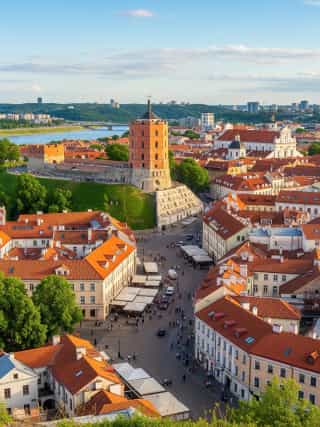
Vilnius - The Capital of Lithuania
- Population
- 588,412
- Language
- Lithuanian
- Continent
- Europe
- Since
- 1991
- Eco Ranking
- 21/195
Source: Environmental Performance Index 2024.
About Vilnius
Vilnius was founded in the early 14th century and served as the capital of the Grand Duchy of Lithuania, at its peak one of the largest states in Europe, stretching from the Baltic to the Black Sea. The city passed through Polish-Lithuanian Commonwealth rule, Russian Imperial control from 1795, and German occupation during World War I before Lithuania declared independence in 1918. The interwar period was complicated: Poland seized Vilnius in 1920, and Lithuania was forced to govern from Kaunas for two decades. The Soviet Union occupied Lithuania in 1940 under the Molotov-Ribbentrop Pact, followed by Nazi German occupation from 1941 to 1944. Vilnius's Jewish community, once so substantial the city was known as the "Jerusalem of Lithuania", was almost entirely murdered during the German occupation. Lithuania was reoccupied by the Soviet Union in 1944. On 11 March 1990, Lithuania became the first Soviet republic to declare independence. Soviet forces responded in January 1991, killing 14 civilians at the Vilnius TV Tower. International recognition came in September 1991 following the failed Moscow coup. Lithuania joined both NATO and the EU in 2004. The Vilnius Old Town is one of the largest surviving medieval old towns in northern Europe.
About Lithuania
Lithuania is a parliamentary republic and the largest of the three Baltic states by population. The Seimas (parliament) holds primary legislative authority, and the prime minister leads the government. Lithuania has been a member of both NATO and the EU since 2004. Its location on NATO's eastern flank, bordering Russia's Kaliningrad exclave and Belarus, makes it one of the alliance's most geopolitically exposed members. Lithuania's declaration of independence in 1990 was the catalyst that accelerated the dissolution of the Soviet Union.
View Vilnius on the map
Flight time from Vilnius to other capitals
| City | Distance (km) | Flight Time |
|---|---|---|
| London | 1700 | 2h 0m |
| Paris | 1700 | 2h 0m |
| Rome | 1700 | 2h 0m |
| Abu Dhabi | 4100 | 4h 49m |
| Washington, D.C. | 7300 | 8h 35m |
| Tokyo | 8200 | 9h 39m |
| Singapore | 9200 | 10h 49m |
| Cape Town | 9900 | 11h 39m |
| Buenos Aires | 12700 | 14h 56m |
| Canberra | 15300 | 18h 0m |
Capitals with similar population to Vilnius
| City | Population |
|---|---|
| Copenhagen | 658,390 |
| Djibouti | 623,891 |
| Riga | 614,618 |
| Vilnius | 588,412 |
| Skopje | 584,000 |
| San Salvador | 525,990 |
| Juba | 525,953 |
Capitals with similar eco ranking to Vilnius
Source: Environmental Performance Index 2024.
Frequently Asked Questions
When did Vilnius become the capital of Lithuania?
Vilnius has been the Lithuanian capital since the early 14th century, when Grand Duke Gediminas established it as the seat of the Grand Duchy of Lithuania. However, during the interwar period (1920-1939), Poland controlled Vilnius and Lithuania governed from Kaunas. Vilnius was restored as the capital when Lithuania re-established independence.
Why was Lithuania's independence declaration historically significant?
On 11 March 1990, Lithuania became the first Soviet republic to declare independence from the USSR. This act triggered a major constitutional and political crisis within the Soviet Union and set a precedent that other republics followed, accelerating the USSR's eventual dissolution in 1991.
What happened in Vilnius in January 1991?
Soviet forces, including paratroopers and KGB troops, moved against Lithuanian independence on the night of 12-13 January 1991. They seized the Vilnius TV Tower and other infrastructure. Fourteen civilians were killed defending the tower against armoured vehicles. The events drew international condemnation and strengthened Lithuanian resolve.
What was the Grand Duchy of Lithuania?
The Grand Duchy of Lithuania was a major European state that existed from the 13th to the 18th century. At its greatest extent in the 15th century, it stretched from the Baltic Sea to the Black Sea, encompassing modern Lithuania, Belarus, Ukraine, and parts of Poland and Russia. Vilnius served as its capital from the early 14th century.
Is Vilnius the largest city in Lithuania?
Yes, Vilnius is the largest city in Lithuania with around 590,000 inhabitants, followed by Kaunas and Klaipėda. Vilnius accounts for roughly a fifth of the country's total population.
Sights and landmarks
Climate and best time to visit
Culture and customs