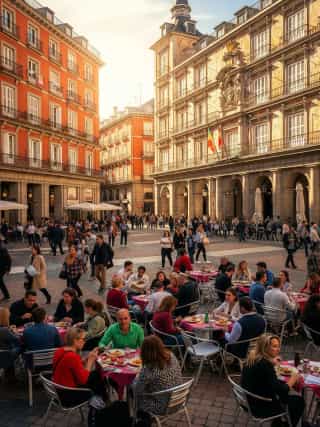
Madrid - The Capital of Spain
- Population
- 6,642,000
- Language
- Spanish
- Continent
- Europe
- Since
- 1561
- Eco Ranking
- 22/195
Source: Environmental Performance Index 2024.
About Madrid
Madrid became the capital of Spain in 1561 when King Philip II permanently established the royal court there, choosing a geographically central location on the Castilian plateau. Before this decision, the Spanish court had moved between Toledo, Valladolid, Burgos, and other cities. Madrid had no prior significance as a major city or ecclesiastical center, its elevation to capital was an administrative decision, not a reflection of existing importance. Philip II's choice of Madrid made it the only European capital created essentially by royal decree without prior urban prominence. The city became the seat of the Spanish Empire at its height, overseeing territories across Europe, the Americas, Africa, and Asia. Spain's 20th-century history was defined by the Civil War (1936-1939), in which Madrid was a Republican stronghold that withstood a three-year siege before falling to Francisco Franco's Nationalist forces. Franco's dictatorship (1939-1975) was headquartered in Madrid, centralizing power and suppressing regional languages and identities. Following Franco's death, Spain transitioned to a constitutional monarchy and parliamentary democracy. Today Madrid is the seat of the Cortes Generales (parliament), the government, and the royal palace. Spain has one of the most decentralized governmental structures in Europe through its system of 17 autonomous communities.
About Spain
Spain is a constitutional monarchy with a parliamentary system and seventeen autonomous communities, each with its own government and legislature. The 1978 constitution established the current democratic framework following Franco's death in 1975. Spain is a member of the EU and NATO. The country has faced significant territorial tensions, particularly regarding Catalan independence; a 2017 independence referendum in Catalonia was declared illegal by the Spanish government and Constitutional Court. Spain is the fourth-largest economy in the eurozone.
View Madrid on the map
Flight time from Madrid to other capitals
| City | Distance (km) | Flight Time |
|---|---|---|
| Paris | 1100 | 1h 18m |
| London | 1300 | 1h 32m |
| Rome | 1400 | 1h 39m |
| Abu Dhabi | 5600 | 6h 35m |
| Washington, D.C. | 6100 | 7h 11m |
| Cape Town | 8600 | 10h 7m |
| Buenos Aires | 10000 | 11h 46m |
| Tokyo | 10800 | 12h 42m |
| Singapore | 11400 | 13h 25m |
| Canberra | 17600 | 20h 42m |
Capitals with similar population to Madrid
Capitals with similar eco ranking to Madrid
Source: Environmental Performance Index 2024.
Frequently Asked Questions
Why did Philip II choose Madrid as the capital of Spain?
Philip II moved the royal court permanently to Madrid in 1561, primarily because of its central geographic position on the Iberian Peninsula, which he believed would allow more effective administration of the sprawling Spanish kingdoms. The site was also a royal hunting ground with an existing small royal residence. Madrid had no prior status as a major city, cathedral city, or commercial center.
When did Madrid become the capital of Spain?
Madrid became the permanent capital of Spain in 1561 when Philip II established the royal court there. It briefly lost that status from 1601 to 1606, when Philip III moved the court to Valladolid, before it was returned to Madrid definitively in 1606.
What was Madrid's role in the Spanish Civil War?
Madrid was the seat of the Spanish Republican government and a key military objective for Franco's Nationalist forces. The city withstood a prolonged siege from November 1936 until March 1939, nearly the full duration of the Civil War. The defense of Madrid, including the Battle of Jarama and the defense of the University City, became symbolic of Republican resistance. The city finally fell on 28 March 1939.
Is Madrid the largest city in Spain?
Yes, Madrid is the largest city in Spain, with approximately 3.3 million residents in the city proper and over 6.6 million in the wider metropolitan area. It is followed by Barcelona, which has a comparable metropolitan area population and serves as the capital of Catalonia.
How does Spain's autonomous community system affect Madrid's role as capital?
Spain's 17 autonomous communities each have their own elected parliaments and governments with authority over education, health, policing, and other domains. Madrid is both the national capital and the capital of the Autonomous Community of Madrid. The tension between central authority in Madrid and the demands of regions such as Catalonia and the Basque Country has been one of the defining political conflicts of post-Franco Spain.
Sights and landmarks
Climate and best time to visit
Culture and customs