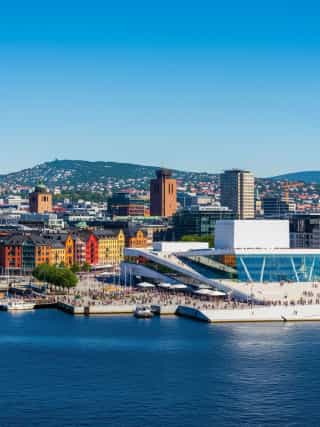
Oslo - The Capital of Norway
- Population
- 697,549
- Language
- Norwegian
- Continent
- Europe
- Since
- 1814
- Eco Ranking
- 7/195
Source: Environmental Performance Index 2024.
About Oslo
Oslo has been the seat of Norwegian political power since the dissolution of the union with Denmark in 1814, when Norway adopted its constitution and the Storting, the Norwegian Parliament, first convened in the city. The capital's name has changed twice: founded in the early 11th century, it was renamed Christiania in 1624 after a fire and subsequent rebuilding under Danish King Christian IV, then respelled Kristiania in 1877, before reverting to Oslo in 1925. The city's political history runs through Norway's long dual subordination, first to Denmark, then to Sweden, and its eventual independence. When Norway dissolved its union with Sweden in 1905, it did so through a peaceful referendum in which over 99% voted for independence, a remarkably bloodless separation. The Storting has functioned continuously in Oslo since 1814, interrupted only by the German occupation of 1940-1945, during which the Nazi-installed government of Vidkun Quisling operated from the city. Norway is today a constitutional monarchy; the Royal Palace and the Storting both sit in central Oslo. The Nobel Peace Prize ceremony is held in Oslo's City Hall annually.
About Norway
Norway is a constitutional monarchy with a parliamentary system of government. The Storting functions as a unicameral legislature with 169 seats. Executive power rests with the cabinet, led by the prime minister. Norway is not a member of the European Union but participates in the European single market through the EEA agreement, a relationship subject to recurring domestic political debate.
View Oslo on the map
Flight time from Oslo to other capitals
| City | Distance (km) | Flight Time |
|---|---|---|
| London | 1200 | 1h 25m |
| Paris | 1300 | 1h 32m |
| Rome | 2000 | 2h 21m |
| Abu Dhabi | 5200 | 6h 7m |
| Washington, D.C. | 6200 | 7h 18m |
| Tokyo | 8400 | 9h 53m |
| Singapore | 10000 | 11h 46m |
| Cape Town | 10500 | 12h 21m |
| Buenos Aires | 12300 | 14h 28m |
| Canberra | 16000 | 18h 49m |
Capitals with similar population to Oslo
| City | Population |
|---|---|
| Zagreb | 769,944 |
| Oslo | 697,549 |
| Washington, D.C. | 689,545 |
| Chișinău | 685,889 |
| Helsinki | 658,864 |
| Copenhagen | 658,390 |
| Djibouti | 623,891 |
Capitals with similar eco ranking to Oslo
Source: Environmental Performance Index 2024.
Frequently Asked Questions
Why is Oslo the capital of Norway?
Oslo became the capital in 1814 when Norway adopted its constitution and the Storting first convened there following the dissolution of the union with Denmark. The city had long been the main administrative and commercial center of southern Norway and was the natural seat of the new parliament.
What was Oslo called before it was renamed Oslo?
The city was called Christiania from 1624, after Danish King Christian IV had it rebuilt following a fire, and the spelling was changed to Kristiania in 1877. The name Oslo, the city's original medieval name, was officially restored in 1925.
When did Norway gain independence?
Norway formally dissolved its union with Sweden on June 7, 1905, after the Storting voted to end the union and a subsequent national referendum saw over 99% of voters support independence. Sweden accepted the dissolution peacefully. Norway had previously been in union with Denmark from 1380 to 1814.
Is Oslo the largest city in Norway?
Yes, Oslo is both the capital and the largest city in Norway, with a city population of approximately 697,000 and a greater metropolitan area of around 1 million. It is the economic, political, and administrative center of the country.
Where does the Norwegian Parliament meet?
The Norwegian Parliament, the Storting, meets in the Storting building in central Oslo, completed in 1866. The Storting has convened in Oslo continuously since 1814, with the exception of the German occupation during World War II.
Sights and landmarks
Climate and best time to visit
Economy