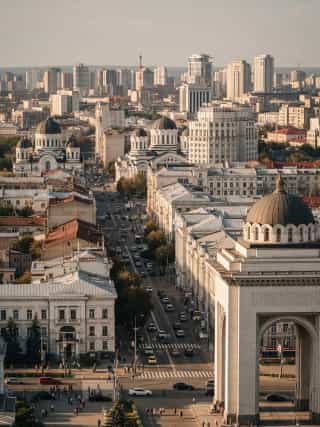
Chișinău - The Capital of Moldova
- Population
- 685,889
- Language
- Romanian
- Continent
- Europe
- Since
- 1991
- Eco Ranking
- 88/195
Source: Environmental Performance Index 2024.
About Chișinău
Chișinău became the administrative center of the region of Bessarabia under Russian Imperial rule in the early 19th century and served as the capital of the Moldavian Soviet Socialist Republic from 1940 (with interruption during World War II) until the dissolution of the USSR. Moldova declared independence in 1991, and Chișinău became the capital of the new republic. The city sits west of the Dniester River, which has become a political fault line: to the east lies Transnistria, a breakaway region that declared independence in 1990, is heavily militarized, has a significant Russian military presence, and is not recognized by any UN member state. Moldova's political history since independence has been defined by the tension between pro-European and pro-Russian orientations, with governments oscillating between these poles. The election of Maia Sandu as president in 2020 and Moldova's EU candidate status granted in 2022 represented a decisive shift toward European integration. The parliament (Parlamentul Republicii Moldova) and the presidency are both located in Chișinău. Moldova and Romania share the same official language, and the question of national identity, Moldovan versus Romanian, remains politically contested.
About Moldova
Moldova is a parliamentary republic in which the prime minister holds most executive power, though a 2023 constitutional amendment strengthened direct presidential authority. The country has one of the lowest GDPs per capita in Europe. Moldova applied for EU membership in 2022 and was granted candidate status the same year. The Transnistrian conflict, a frozen conflict with a Russian military presence, remains unresolved and is a central constraint on Moldovan sovereignty and foreign policy options.
View Chișinău on the map
Flight time from Chișinău to other capitals
| City | Distance (km) | Flight Time |
|---|---|---|
| Rome | 1400 | 1h 39m |
| Paris | 2000 | 2h 21m |
| London | 2100 | 2h 28m |
| Abu Dhabi | 3400 | 4h 0m |
| Washington, D.C. | 8000 | 9h 25m |
| Tokyo | 8500 | 10h 0m |
| Singapore | 8800 | 10h 21m |
| Cape Town | 9100 | 10h 42m |
| Buenos Aires | 12600 | 14h 49m |
| Canberra | 15000 | 17h 39m |
Capitals with similar population to Chișinău
| City | Population |
|---|---|
| Oslo | 697,549 |
| Washington, D.C. | 689,545 |
| Chișinău | 685,889 |
| Helsinki | 658,864 |
| Copenhagen | 658,390 |
| Djibouti | 623,891 |
| Riga | 614,618 |
Capitals with similar eco ranking to Chișinău
Source: Environmental Performance Index 2024.
Frequently Asked Questions
What is Transnistria and how does it affect Chișinău's role as capital?
Transnistria is a breakaway region in eastern Moldova, east of the Dniester River, that declared independence in 1990 and has operated as a de facto separate state since 1992. It is not recognized by any UN member state. Chișinău governs Moldova proper but has no administrative authority over Transnistrian territory, limiting the capital's effective jurisdiction.
When did Chișinău become the capital of independent Moldova?
Chișinău became the capital of independent Moldova on 27 August 1991, when Moldova declared independence from the Soviet Union. Prior to independence, it had been the capital of the Moldavian Soviet Socialist Republic since 1940.
Is Moldova pursuing EU membership?
Yes. Moldova applied for EU membership in March 2022, shortly after Russia's full-scale invasion of Ukraine, and was granted EU candidate status in June 2022. Accession negotiations opened in 2024. Chișinău's political orientation has shifted decisively toward European integration under President Maia Sandu.
What is the relationship between Moldova and Romania?
Moldova and Romania share the same official language (referred to as Romanian in Romania and, since a 2023 constitutional change, also officially Romanian in Moldova). The two countries were united briefly between 1918 and 1940. Many Moldovan citizens hold Romanian, and thus EU, passports. Whether Moldovan national identity is distinct from Romanian identity remains politically contested.
Is Chișinău the largest city in Moldova?
Yes, Chișinău is by far the largest city in Moldova, with approximately 686,000 residents, more than a quarter of the country's total population. It is the country's primary economic, political, and educational center.
Sights and landmarks
Climate and best time to visit
Culture and customs
Economy