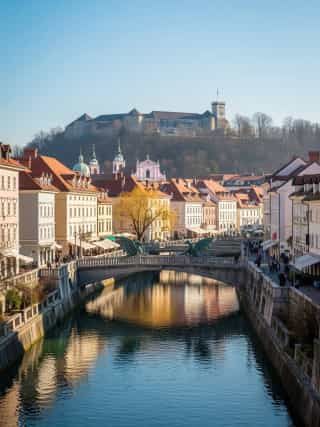
Ljubljana - The Capital of Slovenia
- Population
- 295,504
- Language
- Slovenian
- Continent
- Europe
- Since
- 1991
- Eco Ranking
- 24/195
Source: Environmental Performance Index 2024.
About Ljubljana
Ljubljana became the capital of an independent Slovenia on 25 June 1991, when Slovenia declared independence from the Socialist Federal Republic of Yugoslavia. The declaration was followed by the Ten-Day War, a brief armed conflict with the Yugoslav People's Army that resulted in minimal casualties and ended with Yugoslav forces withdrawing from Slovenian territory. It was among the most peaceful separations in European history. Ljubljana had previously served as the capital of the Socialist Republic of Slovenia within Yugoslavia, and before that as the capital of the Duchy of Carniola under Habsburg rule. The city has Roman origins and has been continuously inhabited for over two thousand years. Slovenia joined both NATO and the European Union in March and May 2004, respectively, one of the fastest integrations of a post-communist state into Western institutions. Ljubljana is the seat of the National Assembly, the president's office, and the government. The Constitutional Court and Supreme Court are also based there. At under 300,000 residents, Ljubljana is one of the smallest capitals in the European Union. Slovenia was the first post-Yugoslav state to adopt the euro, doing so in 2007.
About Slovenia
Slovenia is a parliamentary republic in Central Europe, bordered by Austria, Italy, Hungary, and Croatia. It was the most economically developed of the Yugoslav republics at the time of its independence. Slovenia's transition to democracy and a market economy was rapid and relatively smooth compared to other post-communist states. It has been a member of the EU, NATO, the Schengen Area, and the eurozone. The country has a population of approximately 2.1 million and maintains one of the highest standards of living among former Eastern Bloc states.
View Ljubljana on the map
Flight time from Ljubljana to other capitals
| City | Distance (km) | Flight Time |
|---|---|---|
| Rome | 500 | 0h 35m |
| Paris | 1000 | 1h 11m |
| London | 1200 | 1h 25m |
| Abu Dhabi | 4300 | 5h 4m |
| Washington, D.C. | 7100 | 8h 21m |
| Cape Town | 8900 | 10h 28m |
| Tokyo | 9400 | 11h 4m |
| Singapore | 9800 | 11h 32m |
| Buenos Aires | 11600 | 13h 39m |
| Canberra | 16100 | 18h 56m |
Capitals with similar population to Ljubljana
| City | Population |
|---|---|
| Manama | 330,000 |
| Ciudad de la Paz | 297,000 |
| Ljubljana | 295,504 |
| Sucre | 280,585 |
| Dili | 277,279 |
| Nassau | 274,400 |
| Porto-Novo | 264,320 |
Capitals with similar eco ranking to Ljubljana
Source: Environmental Performance Index 2024.
Frequently Asked Questions
When did Ljubljana become the capital of Slovenia?
Ljubljana became the capital of independent Slovenia on 25 June 1991, when Slovenia declared independence from Yugoslavia. The brief Ten-Day War that followed ended with a ceasefire brokered by the European Community. Slovenia's independence was internationally recognized in January 1992.
Why was Slovenia's independence relatively peaceful?
Several factors contributed: Slovenia was ethnically homogeneous with a very small Serb minority, meaning Belgrade had less political motivation to contest its secession than it did in Croatia or Bosnia. The Yugoslav federal army's brief intervention ended quickly, partly because Slovenia had effectively secured its borders and partly due to international pressure. The Brioni Agreement of July 1991 ended the conflict.
Was Ljubljana always the capital of Slovenia?
Ljubljana has been the main city of the Slovenian-inhabited lands for centuries. It was the capital of the Duchy (later Province) of Carniola under Habsburg rule, then became the capital of the Socialist Republic of Slovenia within Yugoslavia in 1945. When Slovenia became independent in 1991, Ljubljana's status as capital was a natural continuation.
Is Ljubljana the largest city in Slovenia?
Yes, Ljubljana is the largest city in Slovenia with approximately 295,000 residents in the city proper and around 540,000 in the wider urban region. This makes it one of the smaller European capitals in absolute terms, reflecting Slovenia's overall modest population of about 2.1 million.
When did Slovenia join the European Union?
Slovenia joined the European Union on 1 May 2004, as part of the EU's largest single enlargement round, which brought in ten new member states. Slovenia was also among the earliest post-communist EU members to adopt the euro, doing so on 1 January 2007.
Sights and landmarks
Climate and best time to visit
Regional significance