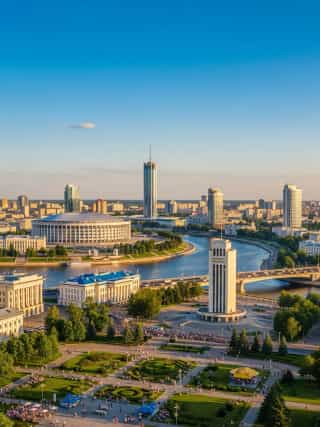
Minsk - The Capital of Belarus
- Population
- 1,982,444
- Language
- Belarusian
- Continent
- Europe
- Since
- 1067
- Eco Ranking
- 32/195
Source: Environmental Performance Index 2024.
About Minsk
Minsk has served as the capital of Belarus since the medieval period, with its political status consolidated through successive Polish-Lithuanian, Russian imperial, and Soviet periods of rule. The city was almost completely destroyed during World War II, over 80 percent of its buildings were razed during the German occupation from 1941 to 1944. It was rebuilt in Stalinist architectural style, giving it wide boulevards and monumental public buildings that remain defining features today. After the dissolution of the Soviet Union in 1991, Minsk became the capital of independent Belarus and was simultaneously designated the administrative center of the Commonwealth of Independent States (CIS). Alexander Lukashenko has ruled Belarus since 1994, making him Europe's longest-serving head of government. The 2020 presidential election, which Lukashenko claimed to have won with 80 percent of the vote, was widely rejected as fraudulent. Mass protests followed, centered in Minsk, and were suppressed with force. Lukashenko retained power with direct Russian backing. Belarus is the only European country whose government faces comprehensive EU and US sanctions for human rights abuses against its own citizens.
About Belarus
Belarus is a presidential republic in which Alexander Lukashenko, in power since 1994, holds near-total authority. The constitution was amended in a 2022 referendum, held amid the crackdown on dissent, to permanently bar Lukashenko from future prosecution and to embed Belarus more deeply in its alliance with Russia. Belarus and Russia maintain a Union State framework, the deepest integration short of full merger of any two post-Soviet states. Following Russia's 2022 invasion of Ukraine, Belarus allowed Russian forces to use its territory as a launching point, drawing international condemnation and severe economic sanctions.
View Minsk on the map
Flight time from Minsk to other capitals
| City | Distance (km) | Flight Time |
|---|---|---|
| Rome | 1700 | 2h 0m |
| Paris | 1800 | 2h 7m |
| London | 1900 | 2h 14m |
| Abu Dhabi | 4000 | 4h 42m |
| Washington, D.C. | 7400 | 8h 42m |
| Tokyo | 8100 | 9h 32m |
| Singapore | 9000 | 10h 35m |
| Cape Town | 9800 | 11h 32m |
| Buenos Aires | 12800 | 15h 4m |
| Canberra | 15100 | 17h 46m |
Capitals with similar population to Minsk
| City | Population |
|---|---|
| Phnom Penh | 2,129,371 |
| Havana | 2,106,146 |
| Damascus | 2,079,000 |
| Minsk | 1,982,444 |
| Panama City | 1,938,000 |
| Vienna | 1,911,191 |
| Bucharest | 1,883,425 |
Capitals with similar eco ranking to Minsk
| City | Eco Rank |
|---|---|
| Rome | 29 |
| Riga | 30 |
| Budapest | 31 |
| Minsk | 32 |
| Bucharest | 34 |
| Wellington | 34 |
| Washington, D.C. | 35 |
Source: Environmental Performance Index 2024.
Frequently Asked Questions
Why is Minsk the capital of Belarus?
Minsk has been the main administrative center of the region for centuries, serving as a capital during the Grand Duchy of Lithuania, the Russian Empire, and the Soviet period as capital of the Byelorussian SSR. When Belarus declared independence in 1991, Minsk naturally continued as the national capital.
Was Minsk destroyed in World War II?
Yes. Minsk suffered catastrophic destruction during the German occupation from 1941 to 1944. Over 80 percent of the city's buildings were destroyed, and a significant portion of the population was killed. The city was subsequently rebuilt in the Stalinist architectural style, which still dominates the city center.
Why is Belarus called Europe's last dictatorship?
The term refers to the government of Alexander Lukashenko, who has ruled since 1994 without permitting free and fair elections. After the disputed 2020 election and the violent suppression of protests that followed, the EU, US, and UK imposed broad sanctions on Belarus. No other European government faces equivalent democratic deficit or sanctions.
What is the Commonwealth of Independent States and why is it based in Minsk?
The Commonwealth of Independent States (CIS) is a regional organization of post-Soviet states, formed in 1991 following the dissolution of the USSR. Minsk was chosen as its administrative headquarters because the founding agreement, the Belavezha Accords, which dissolved the Soviet Union, was signed in Belarus in December 1991.
Is Minsk the largest city in Belarus?
Yes. Minsk is by far the largest city in Belarus, with a population of approximately 1.98 million, roughly a fifth of the entire country's population. The next largest cities, Gomel and Vitebsk, have fewer than 500,000 residents each.
Sights and landmarks
Climate and best time to visit
Culture and customs
Economy