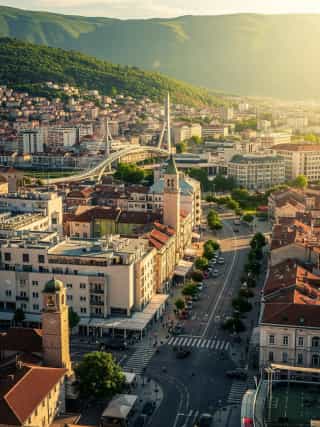
Podgorica - The Capital of Montenegro
- Population
- 187,085
- Language
- Montenegrin
- Continent
- Europe
- Since
- 2006
- Eco Ranking
- 78/195
Source: Environmental Performance Index 2024.
About Podgorica
Podgorica became the capital of an independent Montenegro in June 2006, following a closely watched independence referendum in which 55.5% voted to separate from the State Union of Serbia and Montenegro, just barely clearing the internationally mandated threshold of 55%. It was the final act of dissolution of the former Yugoslavia, completing a process that had produced seven successor states over fifteen years. During the Yugoslav period, the city was known as Titograd from 1946 to 1992, named after Yugoslav leader Josip Broz Tito. The city suffered extensive damage during World War II, bombed both by the Axis powers and Allied forces, and was largely rebuilt in the socialist architectural style of the postwar era. Historically, the nearby royal capital of Cetinje held greater political prestige, it served as the capital of the Kingdom of Montenegro until 1918, and retains ceremonial capital status today. Podgorica functions as the administrative, political, and economic center. The Parliament of Montenegro and government ministries are headquartered there. Montenegro joined NATO in 2017, a significant geopolitical alignment given the country's historical and cultural ties to Serbia and Russia. EU accession negotiations are ongoing, with Montenegro considered among the most advanced candidates in the Western Balkans.
About Montenegro
Montenegro is a parliamentary republic and NATO member state. The unicameral Parliament elects the government. Since independence in 2006, Montenegrin politics has been defined by the long dominance of the Democratic Party of Socialists and a gradual, contested shift toward EU and NATO integration. The country formally opened EU accession negotiations in 2012 and remains a candidate.
View Podgorica on the map
Flight time from Podgorica to other capitals
| City | Distance (km) | Flight Time |
|---|---|---|
| Rome | 600 | 0h 42m |
| Paris | 1500 | 1h 46m |
| London | 1800 | 2h 7m |
| Abu Dhabi | 3800 | 4h 28m |
| Washington, D.C. | 7700 | 9h 4m |
| Cape Town | 8500 | 10h 0m |
| Tokyo | 9400 | 11h 4m |
| Singapore | 9500 | 11h 11m |
| Buenos Aires | 11600 | 13h 39m |
| Canberra | 15700 | 18h 28m |
Capitals with similar population to Podgorica
| City | Population |
|---|---|
| Malé | 227,486 |
| Wellington | 215,800 |
| Podgorica | 187,085 |
| Suva | 178,065 |
| Praia | 168,000 |
| Port Louis | 149,194 |
| Gitega | 135,467 |
Capitals with similar eco ranking to Podgorica
| City | Eco Rank |
|---|---|
| Victoria | 76 |
| Astana | 77 |
| Santo Domingo | 78 |
| Podgorica | 78 |
| Amman | 79 |
| Port Louis | 79 |
| Tbilisi | 79 |
Source: Environmental Performance Index 2024.
Frequently Asked Questions
When did Montenegro become an independent country?
Montenegro declared independence on June 3, 2006, following a referendum held on May 21, 2006, in which 55.5% of voters chose independence from the State Union of Serbia and Montenegro. The result met the internationally required 55% threshold by a narrow margin.
What was Podgorica called during the Yugoslav era?
Podgorica was renamed Titograd in 1946, in honor of Yugoslav leader Josip Broz Tito, and the name was used until 1992, when Montenegro was still part of the Federal Republic of Yugoslavia. The city reverted to its historical name, Podgorica, in 1992.
Is Cetinje or Podgorica the capital of Montenegro?
Podgorica is the functional capital and seat of government of Montenegro. Cetinje holds the formal title of Old Royal Capital and retains ceremonial significance as the historic seat of the Kingdom of Montenegro, but all government institutions operate from Podgorica.
When did Montenegro join NATO?
Montenegro became a NATO member state on June 5, 2017, making it the 29th member of the alliance. The accession was controversial domestically and was opposed by Russia, which has historically regarded Montenegro as culturally and politically aligned with Serbia.
Is Montenegro a candidate to join the European Union?
Yes. Montenegro opened EU accession negotiations in 2012 and is considered one of the most advanced candidates among the Western Balkan states. All 33 negotiating chapters have been opened, though the process has advanced slowly due to concerns about rule of law and judicial reform.
Sights and landmarks
Climate and best time to visit
Regional significance
Culture and customs