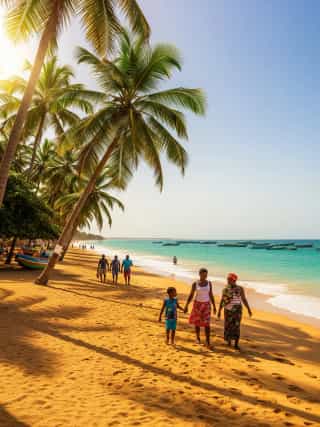
Praia - The Capital of Cape Verde
- Population
- 168,000
- Language
- Portuguese
- Continent
- Africa
- Since
- 1975
- Eco Ranking
- 138/195
Source: Environmental Performance Index 2024.
About Praia
Praia is the capital of Cape Verde, an archipelago of ten volcanic islands in the Atlantic Ocean off the West African coast. The islands were completely uninhabited when Portuguese navigators arrived in 1456, making Cape Verde one of the few countries in the world with no indigenous pre-colonial population. Praia, on the island of Santiago, developed as a significant node in the Atlantic slave trade, serving as a transit point between Africa and the Americas. Cape Verde remained a Portuguese territory for over five centuries before gaining independence on July 5, 1975, as part of the broader decolonization wave that followed the Portuguese Carnation Revolution of 1974. The country was initially ruled by the African Party for the Independence of Guinea and Cape Verde (PAIGC), a single-party government, before transitioning to multiparty democracy in 1991 in one of Africa's earlier democratic transitions. Cape Verde is consistently ranked among the most democratic and well-governed states in Africa, with regular peaceful transfers of power. The country's small size, lack of natural resources, and geographic dispersion have shaped its economic dependence on remittances from a large diaspora, the Cape Verdean diaspora abroad is estimated to outnumber the resident population. Praia concentrates the island nation's government, university, and main port on Santiago.
About Cape Verde
Cape Verde is a parliamentary republic in the Atlantic Ocean, comprising two island groups. The unicameral National People's Assembly holds 72 seats. Executive power rests with the prime minister. The country has no indigenous population, all Cape Verdeans descend from Portuguese settlers and enslaved Africans. Cape Verde is a member of the African Union and ECOWAS and maintains a special partnership agreement with the European Union.
View Praia on the map
Flight time from Praia to other capitals
| City | Distance (km) | Flight Time |
|---|---|---|
| Paris | 4400 | 5h 11m |
| London | 4600 | 5h 25m |
| Rome | 4600 | 5h 25m |
| Washington, D.C. | 5800 | 6h 49m |
| Buenos Aires | 6600 | 7h 46m |
| Cape Town | 7000 | 8h 14m |
| Abu Dhabi | 8100 | 9h 32m |
| Singapore | 13900 | 16h 21m |
| Tokyo | 14100 | 16h 35m |
| Canberra | 17600 | 20h 42m |
Capitals with similar population to Praia
Capitals with similar eco ranking to Praia
Source: Environmental Performance Index 2024.
Frequently Asked Questions
When did Cape Verde gain independence?
Cape Verde gained independence from Portugal on July 5, 1975, following the Portuguese Carnation Revolution of April 1974, which ended the Estado Novo dictatorship and accelerated the decolonization of all Portuguese African territories.
Was Cape Verde inhabited before the Portuguese arrived?
No. The Cape Verde archipelago had no indigenous human population when Portuguese explorers arrived in the mid-15th century. The islands were settled by Portuguese colonizers and enslaved Africans brought from the West African mainland, making Cape Verdean identity entirely post-colonial in origin.
Why is Cape Verde considered one of Africa's most stable democracies?
Cape Verde transitioned to multiparty democracy in 1991, one of the earliest such transitions in Africa, and has since held regular elections with multiple peaceful transfers of power between competing parties. The country consistently ranks near the top of African governance and democratic freedom indices.
What is the significance of Cape Verde's diaspora?
Cape Verde has a large emigrant diaspora, estimated at over 500,000 people, living primarily in Portugal, the United States, the Netherlands, and other countries. The diaspora is estimated to be larger than the country's resident population of around 500,000, and remittances from diaspora members constitute a major source of national income.
Is Praia the largest city in Cape Verde?
Yes, Praia on Santiago island is the largest city in Cape Verde and the seat of national government. It contains approximately one-third of the country's total population and is significantly larger than the second city, Mindelo, on the island of São Vicente.
Sights and landmarks
Culture and customs
Economy